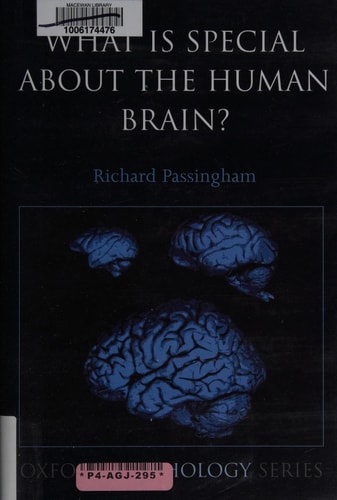
What is Special About the Human Brain?
0
0
As an Amazon Associate and affiliate partner, Menrva Books earns from qualifying purchases. Learn more
Author Description
It is plausible that evolution could have created the human skeleton, but it is hard to believe that it created the human mind. Yet, in six or seven million years evolution came up with Homo sapiens, a creature unlike anything the world had ever known. The mental gap between man and ape is immense, and yet evolution bridged that gap in so short a space of time. Since the brain is the organ of the mind, it is natural to assume that during the evolution of our hominid ancestors there were changes in the brain that can account for this gap. This book is a search for those changes.It is not enough to understand the universe, the world, or the animal kingdom: we need to understand ourselves. Humans are unlike any other animal in dominating the earth and adapting to any environment. This book searches for specializations in the human brain that make this possible. As well as considering the anatomical differences, it examines the contribution of different areas of the brain - reviewing studies in which functional brain imaging has been used to study the brain mechanisms that are involved in perception, manual skill, language, planning, reasoning, and social cognition. It considers a range of skills unique to us - for example our ability to learn a language and pass on cultural traditions in this way, and become aware of our own throughts through inner speechWritten in a lively style by a distinguished scientist who has made his own major contribution to our understanding of the mind, the book is a far-reaching and exciting quest to understand those things that make humans unique.
Menrva's Summary
THE THESIS
This book investigates the specific neuroanatomical and functional specializations of the human brain that account for the cognitive gap between humans and other primates. Richard Passingham, a distinguished neuroscientist, synthesizes evolutionary biology and functional brain imaging data to examine how hominid brain development facilitated unique human capabilities. The text argues that understanding these biological adaptations is essential to explaining human dominance and our capacity for complex culture, language, and reasoning.
THE SCOPE MAP
What You Will Find
- Comparative neuroanatomy between human and non-human primate brain structures.
- Analysis of functional brain imaging studies regarding perception, manual skill, and social cognition.
- Examination of cognitive mechanisms underlying language acquisition and cultural transmission.
- Discussion of the evolution of self-awareness and inner speech as unique human traits.
THE AUTHORITY PERSPECTIVE
Experts recognize this work as a highly accessible synthesis of complex neuroscientific research for both students and interested laypeople. Readers frequently note that the author successfully balances rigorous anatomical detail with broader evolutionary questions.
Page Count:
288
Publication Date:
2008-07-15
Publisher:
Oxford University Press
ISBN-10:
0199230137
ISBN-13:
9780199230136
Psychology
Evolutionary Biology
Evolutionary Psychology
Anthropology
Neuroscience
Community Tags
Similar Books