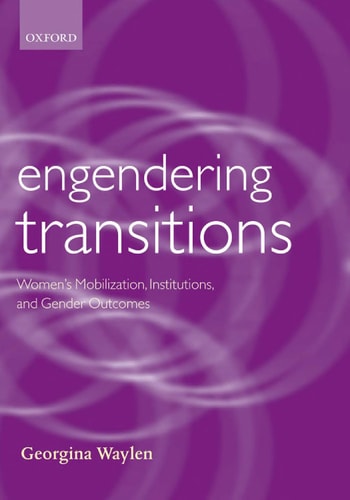
Engendering Transitions: Women's Mobilization, Institutions and Gender Outcomes
0
0
As an Amazon Associate and affiliate partner, Menrva Books earns from qualifying purchases. Learn more
Author Description
What has been the impact of transitions to democracy on gender relations? What roles have women's mobilizations played in processes of democratization? In a new and over-arching thematic analysis, Engendering Transitions answers these questions by comparing the transitions from state socialism and authoritarianism that took place as part of the "third wave" of democratization that swept the world from the mid 1970s onwards.Using empirical material drawn from eight case study countries in East Central Europe and Latin America as well as South Africa, Georgina Waylen explores the gendered constraints and opportunities provided by processes of democratization and economic restructuring. This book uses a sophisticated analytical framework that brings together the analysis of key actors and institutions and shows that, under certain conditions, transitions to democracy can result in some positive gender outcomes such as improvements in women's political representation and more 'gender sensitive' policy in areas such as domestic violence.Georgina Waylen argues that women's mobilization during transitions is no guarantee of success and change is easier to achieve in some areas than others. Understanding the roles that can be played by organized women's movements, key actors and the wider political environment is crucial in helping us to explain why these gender outcomes vary in different contexts. This book addresses important debates within the study of both comparative politics and gender and politics and substantially improves our understanding of the ways in which transitions to democracy are gendered.
Menrva's Summary
THE THESIS
This book investigates how transitions to democracy during the 'third wave' of the late 20th century influenced gender relations and political outcomes for women. Georgina Waylen, a scholar in comparative politics, utilizes a comparative framework to analyze how institutional structures and women's mobilization efforts interact during periods of regime change. By examining the shift from authoritarianism and state socialism, the author argues that democratization processes are inherently gendered and that outcomes depend heavily on the specific political environment and the strategic capacity of organized movements.
THE SCOPE MAP
What You Will Find
- Comparative analysis of eight countries across East Central Europe, Latin America, and South Africa.
- An analytical framework integrating institutional theory with the study of social actors.
- Empirical evidence examining policy changes regarding domestic violence and political representation.
- A systematic evaluation of the constraints and opportunities inherent in economic and political restructuring.
THE AUTHORITY PERSPECTIVE
Scholars in the field of gender and politics recognize this work as a foundational text for understanding the intersection of democratization and gendered policy outcomes. Readers frequently note the academic rigor of the comparative methodology and the clarity with which the author navigates complex political transitions.
Page Count:
264
Publication Date:
2007-07-19
Publisher:
Oxford University Press
ISBN-10:
0199248044
ISBN-13:
9780199248049
Gender Studies
Political Activity
Democracy
International relations
Sociology
Community Tags
Similar Books