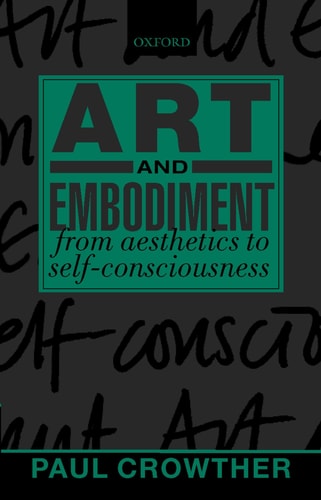
Art and Embodiment: From Aesthetics to Self-Consciousness
0
0
As an Amazon Associate and affiliate partner, Menrva Books earns from qualifying purchases. Learn more
Author Description
In his Critical Aesthetics and Postmodernism, Paul Crowther argued that art and aesthetic experiences have the capacity to humanize. In Art and Embodiment he develops this theme in much greater depth, arguing that art can bridge the gap between philosophy's traditional striving for generality and completeness, and the concreteness and contingency of humanity's basic relation to the world. As the key element in his theory, he proposes an ecological definition of art. His strategy involves first mapping out and analyzing the logical boundaries and ontological structures of the aesthetic domain. He then considers key concepts from this analysis in the light of a tradition in Continental philosophy (notably the work of Kant, Heidegger, Merleau-Ponty, and Hegel) which--by virtue of the philosophical significance that it assigns to art--significantly anticipates the ecological conception. On this basis, Crowther is able to give a full formulation of his ecological definition. Art, in making sensible or imaginative material into symbolic form, harmonizes and conserves what is unique and what is general in human experience. The aesthetic domain answers basic needs intrinsic to self-consciousness itself, and art is the highest realization of such needs. In the creation and reception of art the embodied subject is fully at home with his or her environment.
Menrva's Summary
THE THESIS
How does the creation and reception of art function as a fundamental necessity for human self-consciousness and our embodied relationship with the world? Paul Crowther, a scholar of critical aesthetics, utilizes a framework rooted in Continental philosophy to bridge the divide between abstract philosophical inquiry and the concrete, contingent nature of human existence. By synthesizing the works of Kant, Heidegger, Merleau-Ponty, and Hegel, he constructs an ecological definition of art that posits aesthetic experience as the primary mechanism for harmonizing the unique and general aspects of human experience. The text argues that art serves as the highest realization of the embodied subject's need to find coherence within their environment.
THE SCOPE MAP
What You Will Find
- An analysis of the logical boundaries and ontological structures defining the aesthetic domain.
- A comprehensive ecological definition of art as a symbolic form that mediates human experience.
- A critical synthesis of key concepts from the Continental philosophical tradition.
- An exploration of how art facilitates the humanization of the subject through sensory and imaginative material.
THE AUTHORITY PERSPECTIVE
Scholars and students of aesthetics frequently identify this work as a rigorous expansion of Crowther's earlier theories on the humanizing capacity of art. Readers often note the academic density of the prose, which requires a foundational familiarity with the works of Kant and Heidegger to fully grasp the author's philosophical arguments.
Page Count:
224
Publication Date:
2001-06-21
Publisher:
Oxford University Press
ISBN-10:
0199244979
ISBN-13:
9780199244973
Philosophy
Non-Fiction
Art Theory
Art
Continental Philosophy
Art psychology
Aesthetics
Community Tags
Similar Books