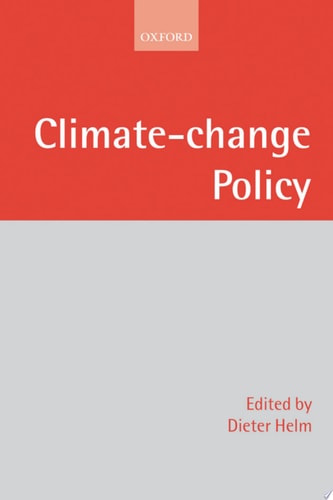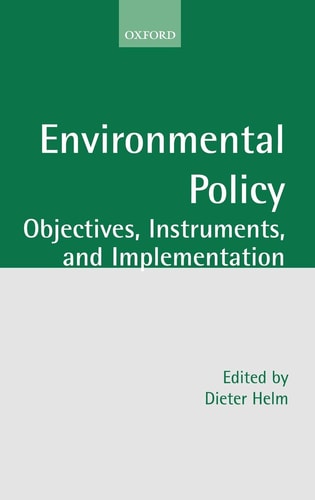
Environmental Policy: Objectives, Instruments, and Implementation
0
0
As an Amazon Associate and affiliate partner, Menrva Books earns from qualifying purchases. Learn more
Author Description
This volume addresses the practical issues that arise in applying economic instruments to environmental policy. It surveys the main concepts and tools--such as sustainability, biodiversity, and cost-benefit analysis--and analyzes the broad environmental policy agenda, including the global agreement on climate change and the narrow British context.
Menrva's Summary
THE THESIS
This volume investigates the practical challenges and economic mechanisms required to implement effective environmental policy in both global and national contexts. Dieter Helm, a prominent economist specializing in energy and environmental policy, utilizes a framework rooted in welfare economics and regulatory theory to evaluate how policy instruments can be applied to complex ecological problems. The text bridges the gap between theoretical economic models and the realities of political implementation, focusing on the trade-offs inherent in environmental management.
THE SCOPE MAP
What You Will Find
- Analysis of economic instruments including taxation, regulation, and market-based incentives.
- Evaluation of core concepts such as sustainability, biodiversity, and cost-benefit analysis.
- Examination of global climate change agreements and their practical limitations.
- Case studies focusing on the British environmental policy landscape.
THE AUTHORITY PERSPECTIVE
Experts frequently cite this work as a foundational text for understanding the intersection of economic theory and environmental governance. Readers often note the analytical rigor of the prose, which provides a clear framework for evaluating policy effectiveness in real-world scenarios.
Page Count:
348
Publication Date:
2001-02-15
Publisher:
Oxford University Press
ISBN-10:
019924135X
ISBN-13:
9780199241354
Economics
Sustainability
Climate Change
Public Policy
Community Tags
Similar Books