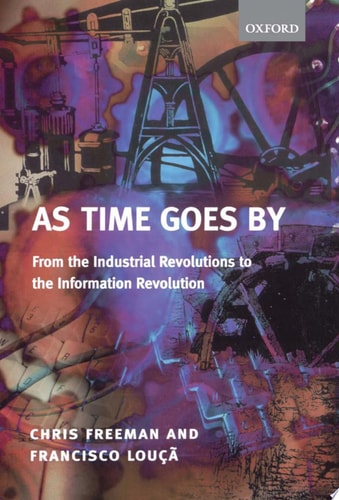
As Time Goes By: From the Industrial Revolutions to the Information Revolution
0
0
As an Amazon Associate and affiliate partner, Menrva Books earns from qualifying purchases. Learn more
Author Description
The Internet and mobile telephones have made everyone more aware than ever of the computer revolution and its effects on the economy and society. 'As Time Goes By' puts this revolution in the perspective of previous waves of technical change: steam-powered mechanization, electrification, and motorization. It argues for a theory of reasoned economic history which assigns a central place to these successive technological revolutions.
Menrva's Summary
THE THESIS
This book investigates the historical pattern of technological revolutions and their cyclical impact on economic development and societal structure. The authors, Chris Freeman and Francisco Louçã, utilize a framework of evolutionary economics to analyze how successive waves of innovation—from steam power to the digital age—shape long-term economic growth. By synthesizing historical data with economic theory, they argue that technological change is the primary driver of structural transformation in modern history.
THE SCOPE MAP
What You Will Find
- Analysis of five distinct technological waves including steam, electricity, and information technology.
- A theoretical framework for reasoned economic history based on innovation cycles.
- Historical case studies examining the transition between industrial paradigms.
- Examination of the social and institutional adjustments required by technological shifts.
THE AUTHORITY PERSPECTIVE
Experts recognize this work as a significant contribution to the study of long-wave economic theory and innovation. Readers frequently note the academic density of the prose, which provides a rigorous foundation for understanding the relationship between technological progress and economic history.
Page Count:
424
Publication Date:
2001-05-03
Publisher:
Oxford University Press
ISBN-10:
0199241074
ISBN-13:
9780199241071
History
Economics
Economic History
Technology
Community Tags
Similar Books