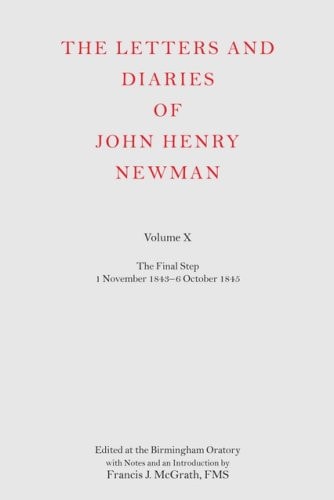
The Letters and Diaries of John Henry Newman, Volume X: The Final Step: 1 November 1843 - 6 October 1845
0
0
As an Amazon Associate and affiliate partner, Menrva Books earns from qualifying purchases. Learn more
Author Description
John Henry Newman (1801-90) was brought up in the Church of England in the Evangelical tradition. An Oxford graduate and Fellow of Oriel College, he was appointed Vicar of St Mary's Oxford in 1828; from 1839 onwards he began to have doubts about the claims of the Anglican Church and in 1845 he was received into the Roman Catholic Church. He was made a Cardinal in 1879. His influence on both the restoration of Roman Catholicism in England and the advance of Catholic ideas in the Church of England was profound.This key volume covers the final twenty-three months of Newman's Anglican years from November 1843 to 6 October 1845. It begins with Francis Rivington's refusal to publish Lives of the English Saints because of their Roman Catholic bias, and Newman's withdrawal from the editorship after the first two volumes of the series is published by another publishing house. The whole country is watching his every move. Rumours are rife and rampant. He is accused of being in the pay of the Pope. He is also accused of being a Jesuit or about to become one. But the attacks which really hit home are those accusing him of being a liar, a sceptic, and a traitor.In February 1845, the University of Oxford's Convocation deprives William George Ward of his BA and MA Oxford degrees; and the proposal to censure Newman's Tract 90 is vetoed by two University Proctors. Newman sets to work in earnest on his Essay on Development, the publication of which will be the signal of his intentions to become a Roman Catholic. It goes to the printers in the third week of September. From this point on, events move swiftly. It is only a matter of days before Newman is received into the Church of Rome by Father Dominic Barberi at Littlemore on 9 October 1845.
Menrva's Summary
THE THESIS
This volume investigates the critical final twenty-three months of John Henry Newman's tenure within the Church of England, documenting the intellectual and social pressures that precipitated his conversion to Roman Catholicism. Francis J. McGrath, a scholar of Newman's life and work, utilizes primary source correspondence and personal diaries to construct a detailed timeline of the events leading to October 1845. The text argues that this period was defined by intense public scrutiny, academic censure, and the internal theological development that culminated in the publication of his Essay on Development. By presenting these documents chronologically, the author provides a granular view of the personal and institutional conflicts that defined Newman's transition.
THE SCOPE MAP
What You Will Find
- Primary source correspondence and diary entries from November 1843 to October 1845.
- Detailed accounts of the controversy surrounding the Lives of the English Saints and Tract 90.
- Documentation of the academic and social fallout within the University of Oxford during the mid-1840s.
- Insight into the theological evolution that led to Newman's reception into the Roman Catholic Church by Father Dominic Barberi.
THE AUTHORITY PERSPECTIVE
Scholars and historians regard this volume as a foundational resource for understanding the Oxford Movement and the personal trajectory of one of the nineteenth century's most significant religious figures. Readers frequently note the academic density of the prose, which serves as an essential reference for those studying the ecclesiastical history of the period.
Page Count:
864
Publication Date:
2006-11-23
Publisher:
OUP/Birmingham Oratory
ISBN-10:
0199254591
ISBN-13:
9780199254590
Biography
Religion
History
Church History
Theology
Community Tags
Similar Books