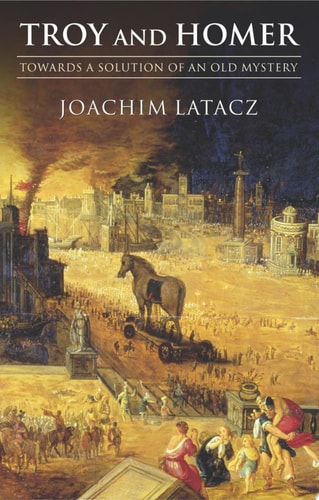
Troy and Homer: Towards a Solution of an Old Mystery
0
0
As an Amazon Associate and affiliate partner, Menrva Books earns from qualifying purchases. Learn more
Author Description
In this book Joachim Latacz turns the spotlight of modern research on the much-debated question of whether the wealthy city of Troy described by Homer in the Iliad was a poetic fiction or a memory of historical reality.Earlier excavations at the hill of Hisarlik, in Turkey, on the Dardanelles, brought no answer, but in 1988 a new archaeological enterprise, under the direction of Manfred Korfmann, led to a radical shift in understanding. Latacz, one of Korfmann's closest collaborators, traces the course of these excavations, and the renewed investigation of the imperial Hittite archives they have inspired. As he demonstrates, it is now clear that the background against which the plot of the Iliad is acted out is the historical reality of the thirteenth century BC. The Troy story as a whole must have arisen in this period, and we can detect traces of it in Homer's great poem.
Menrva's Summary
THE THESIS
This book investigates whether the city of Troy depicted in Homer's Iliad represents a historical reality or merely a work of poetic fiction. Joachim Latacz, a prominent scholar in classical philology, utilizes the findings from the modern archaeological excavations at Hisarlik to bridge the gap between literary tradition and historical evidence. By synthesizing data from the Hittite imperial archives with physical site analysis, he argues that the setting of the Iliad corresponds to the geopolitical landscape of the thirteenth century BC.
THE SCOPE MAP
What You Will Find
- Analysis of the archaeological excavations at the hill of Hisarlik in Turkey.
- Examination of the imperial Hittite archives regarding Western Anatolia.
- Correlation between Homeric epic descriptions and Bronze Age historical records.
- Evaluation of the historical context of the thirteenth century BC as the foundation for the Troy legend.
THE AUTHORITY PERSPECTIVE
Scholars and students of classical antiquity frequently cite this work as a critical synthesis of archaeology and literary analysis. Experts highlight the text for its ability to provide a clear, evidence-based argument that reconciles the Homeric tradition with the physical reality of the Bronze Age.
Page Count:
362
Publication Date:
2005-02-03
Publisher:
Oxford University Press
ISBN-10:
0199263086
ISBN-13:
9780199263080
History
Literary Criticism
Archaeology
Ancient History
Homer
Troy Extinct City
Community Tags
Similar Books