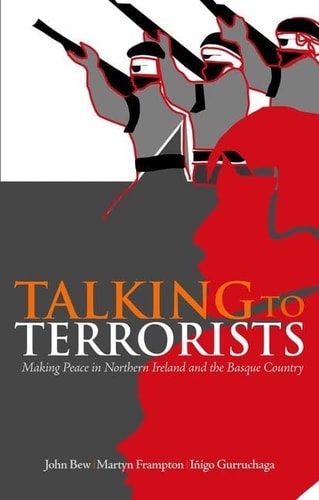
Talking to Terrorists: Making Peace in Northern Ireland and the Basque Country
0
0
As an Amazon Associate and affiliate partner, Menrva Books earns from qualifying purchases. Learn more
Author Description
Product Description The peace agreement in Northern Ireland has been held up as a beacon for conflict resolution around the world. The lessons of Ulster have been applied by prime ministers, presidents, diplomats and intelligence agents to many areas of violent conflict, from Spain to Sri Lanka, from Afghanistanto Iraq and, frequently, the Israel-Palestine crisis. From Belfast to Basra, the notion that it is necessary to engage in dialogue with one's enemies has been fetishised across the political spectrum. Talking to terrorists is a necessary pre-requisite to peace, it is argued, and governments shouldavoid rigid pre-conditions in their attempt to bring in the extremes. But does this understanding really reflect what happened in Northern Ireland? Moreover, does it apply to other areas where democratic governments face threats from terrorist organisations, such as in the Basque region of northernSpain? In challenging this notion, the authors offer an analytical history of the transition from war to peace in Northern Ireland, and compare the violent conflict in the Basque country over the same period, demonstrating how events there have developed very differently than the advocates of 'theNorthern Ireland model' might presume. The authors recognise that governments have often talked to terrorists and will continue to do so in the future. But they argue that what really matters is not the act of talking to terrorists itself but a range of other variables including the role of stateactors, intelligence agencies, hard power and the wider democratic process. Above all, there is a crucial difference between talking to terrorists who believe that their strategy is succeeding and those who have been made to realise that their aims are unattainable by violence.
Menrva's Summary
THE THESIS
This book investigates whether the Northern Ireland peace process serves as a universally applicable model for resolving violent conflicts involving terrorist organizations. The authors, a team of experts in political history and security, utilize a comparative historical framework to analyze the transition from war to peace in Northern Ireland alongside the conflict in the Basque country. They argue that the prevailing consensus—which prioritizes dialogue with terrorists as the primary mechanism for peace—oversimplifies the complex interplay of state power, intelligence operations, and the strategic realization by militants that violence is no longer a viable path to their objectives.
THE SCOPE MAP
What You Will Find
- Comparative analysis of the peace processes in Northern Ireland and the Basque region of Spain.
- Evaluation of the role of state actors, intelligence agencies, and hard power in conflict resolution.
- Examination of the conditions under which dialogue with terrorist organizations becomes effective.
- Critique of the 'Northern Ireland model' as a universal template for modern diplomacy.
THE AUTHORITY PERSPECTIVE
Experts and political analysts recognize this work as a critical intervention in the study of counter-terrorism and diplomatic strategy. Readers frequently note the academic rigor of the prose and the authors' willingness to challenge established narratives regarding the efficacy of unconditional dialogue with militant groups.
Page Count:
256
Publication Date:
2009-06-29
Publisher:
Oxford University Press
ISBN-10:
0199326274
ISBN-13:
9780199326273
Politics
History
Conflict Resolution
Specific Topics
International relations
Europe
World politics
Community Tags
Similar Books