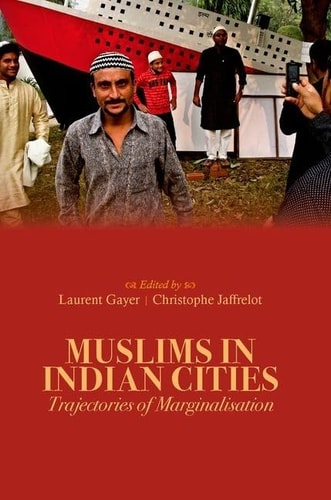
Muslims in Indian Cities: Trajectories of Marginalisation
0
0
As an Amazon Associate and affiliate partner, Menrva Books earns from qualifying purchases. Learn more
Author Description
At more than 150 million people, Muslims are the largest Indian minority but are facing a significant decline in socio-economic as well as political terms--while waves of communal violence have affected them over the last twenty-five years.In India's cities, these developments find contrasting expressions. While Muslims are lagging behind, local syncretic cultures have proved to be resilient in the South and in the East (Bangalore, Calicut, Cuttack). In the Hindi belt and in the North, Muslims have met a different fate, especially in riot-prone areas (Ahmedabad, Mumbai, Jaipur, Aligarh) and in the former capitals of Muslim states (Delhi, Hyderabad, Bhopal, Lucknow).These developments have resulted in the formation of Muslim ghettos and Muslim slums in places like Ahmedabad and Mumbai. But (self-)segregation also played a role in the making of Muslim enclaves, like in Delhi and Aligarh, where traditional elites and the new Muslim middle class searched for physical as well as cultural protection through their regrouping.This book supplements an ethnographic approach to Muslims in eleven Indian cities with a quantitative methodology in order to give a first-hand account of this untold story.
Menrva's Summary
THE THESIS
This book investigates the divergent trajectories of marginalization experienced by Muslim communities across various urban centers in India. Laurent Gayer, a researcher specializing in South Asian politics, utilizes a dual-methodology approach to examine how socio-economic decline and communal violence have shaped the physical and social landscapes of Indian cities. By contrasting the resilience of syncretic cultures in the South and East with the segregation and ghettoization observed in the North and Hindi belt, the author provides a comprehensive framework for understanding the status of India's largest minority group.
THE SCOPE MAP
What You Will Find
- Comparative analysis of eleven distinct Indian cities including Ahmedabad, Mumbai, Delhi, and Bangalore.
- Ethnographic field research combined with quantitative data analysis to track socio-economic trends.
- Examination of the formation of Muslim ghettos, slums, and self-segregated enclaves.
- Analysis of the role of traditional elites and the emerging Muslim middle class in urban spatial politics.
THE AUTHORITY PERSPECTIVE
Experts recognize this work as a significant contribution to the study of urban segregation and minority politics in South Asia. Readers frequently note the academic rigor of the ethnographic data and the clarity with which the author maps complex social phenomena across diverse regional contexts.
Page Count:
320
Publication Date:
2012-02-21
Publisher:
Oxford University Press
ISBN-10:
0199327688
ISBN-13:
9780199327683
Religion
Politics
History
New Used & Rental Textbooks
India
World politics
Sociology
Urban Studies
Community Tags
Similar Books