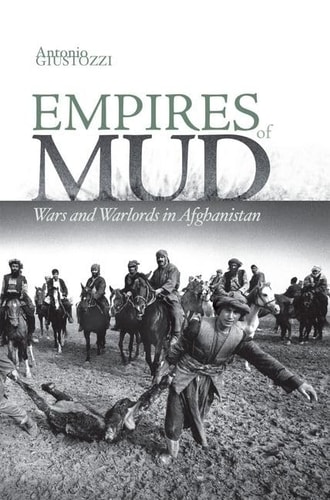
Empires of Mud: Wars and Warlords in Afghanistan
0
0
As an Amazon Associate and affiliate partner, Menrva Books earns from qualifying purchases. Learn more
Author Description
Warlords, namely charismatic military leaders who exploit the weakness of central authorities to seize control of and autonomously rule a sub-national area, have earned much notoriety in recent years on account of the excesses of civil wars in Liberia, Somalia and Afghanistan. But notwithstanding their bad reputation, warlords have often participated in state formation. In Empires of Mud, Giustozzi analyses the dynamics of warlordism in Afghanistan within the context of such debates. He approaches this complex task by first analysing aspects of the Afghan environment that might have been conductive to the fragmentation of central authority and the emergence of warlords and then accounts for the emergence of warlordism in the 1980s and subsequently the lion's share of this book consists of an in-depth analysis of the systems of rule--political, economic, military--which developed under Afghanistan's two foremost warlords, Ismail Khan and Abdul Rashid Dostum, both of whom still wield considerable power even after the intervention of Allied forces in Afghanistan in 2001. Their two systems are compared, highlighting convergences and divergences, in order to explain how warlords administer the areas that they control within so-called "failed states", in the process challenging much of the received wisdom in scholarly and policy circles about warlordism. The author also discusses Ahmad Shah Massoud, whose "system" incorporated elements of rule not dissimilar from that of the warlords. Giustozzi concludes that although charismatic leaders play a key role in shaping the specific characteristics of each warlord polity, there are some common elements that underlie the emergence of warlordism. In particular, the role of local military leaders and their gradual acquisition of a form of "class consciousness" appear to be key processes in allowing the formation of warlord polities, while the latter have repeatedly shown the ability over time to evolve in to more sophisticated structures.
Menrva's Summary
THE THESIS
This book investigates the mechanisms of warlordism in Afghanistan, questioning how military leaders consolidate power and administer territory within the context of a fragmented state. Antonio Giustozzi, a recognized expert on Afghan security and politics, utilizes extensive field research and historical analysis to challenge conventional academic and policy views on failed states. He argues that warlords are not merely agents of chaos but are active participants in state formation, developing distinct political, economic, and military systems that persist despite international intervention.
THE SCOPE MAP
What You Will Find
- Analysis of the Afghan environmental factors that facilitate the fragmentation of central authority.
- Comparative study of the rule of Ismail Khan and Abdul Rashid Dostum.
- Examination of the administrative and military systems developed by regional warlords.
- Discussion of Ahmad Shah Massoud and the evolution of warlord polities into more sophisticated governance structures.
THE AUTHORITY PERSPECTIVE
Experts in the field of conflict studies and South Asian politics regard this work as a rigorous, evidence-based examination of power dynamics in Afghanistan. Readers frequently note the academic density of the prose and the author's ability to provide a nuanced, non-reductionist view of warlord governance.
Page Count:
332
Publication Date:
2012-03-13
Publisher:
Oxford University Press
ISBN-10:
0199326789
ISBN-13:
9780199326785
History
Politics
New Used & Rental Textbooks
Asia
World politics
Afghanistan
Systems Theory
India
International relations
Central Asia
Military History
Community Tags
Similar Books