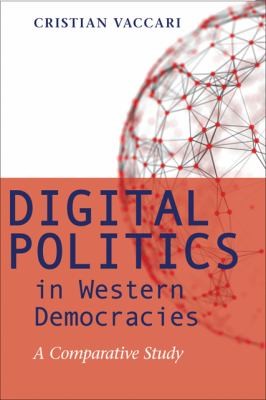
Digital Politics in Western Democracies
0
0
As an Amazon Associate and affiliate partner, Menrva Books earns from qualifying purchases. Learn more
Author Description
Cristian Vaccari presents an analysis of seven advanced Western democracies' digital politics-US, UK, Australia, Germany, Italy, Spain, and France-from 2006 to 2010. Examining the presentation and consumption of website politics, his study not only refutes claims that the web creates homogenized American-style politics and political interaction but also empirically reveals how a nation's unique constraints and opportunities create unique digital responses. This first large scale, comparative treatment of both the supply and demand sides of digital politics among different national political actors is divided into four parts: research methodology and theoretical challenges; how parties and candidates structure their websites (supply); how citizens use websites to access campaign information (demand); and then ties the research results back into his theoretical framework. Because a key aspect of any political system is how political actors communicate, this book will be invaluable for scholars, students, and practitioners interested in political communication, party competition, party organization, political participation, and the study of contemporary media landscapes writ large
Menrva's Summary
THE THESIS
This book investigates the distinct ways digital politics manifest across seven advanced Western democracies, challenging the notion of a globally homogenized online political landscape. Cristian Vaccari, an expert in political communication, analyzes the supply and demand sides of digital politics in the US, UK, Australia, Germany, Italy, Spain, and France between 2006 and 2010. The study refutes claims of American-style political homogenization, demonstrating instead how national contexts shape unique digital political responses. It is structured into four parts: methodology and theory, the supply of political websites by parties and candidates, the demand for campaign information from citizens, and a synthesis of findings with the theoretical framework.
THE SCOPE MAP
- Analysis of digital politics in seven advanced Western democracies (US, UK, Australia, Germany, Italy, Spain, France) from 2006-2010.
- Examination of the supply side: how parties and candidates structure their political websites.
- Examination of the demand side: how citizens use websites to access campaign information.
- Empirical refutation of claims that the internet creates homogenized, American-style politics.
- Demonstration of how unique national constraints and opportunities lead to unique digital political responses.
- Integration of research findings into a theoretical framework on political communication.
- Discussion of research methodology and theoretical challenges in studying digital politics.
THE AUTHORITY PERSPECTIVE
This book is regarded as a significant contribution to the study of political communication and digital politics. Its comparative approach across multiple Western democracies offers a nuanced understanding that moves beyond simplistic notions of global homogenization. The detailed analysis of both the supply and demand sides of online political engagement provides valuable insights for scholars and practitioners alike. The work is particularly noted for its empirical rigor and its challenge to prevailing assumptions about the internet's impact on political systems.
Page Count:
283
Publication Date:
2013-01-01
ISBN-10:
1421411180
ISBN-13:
9781421411187
Non-Fiction
Science
Art
Politics
Comparative Politics
Community Tags
Similar Books