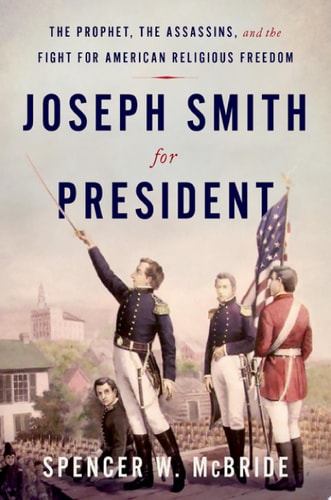
Joseph Smith for President: The Prophet, the Assassins, and the Fight for American Religious Freedom
0
0
As an Amazon Associate and affiliate partner, Menrva Books earns from qualifying purchases. Learn more
Author Description
By the election year of 1844, Joseph Smith, the controversial founder of the Church of Jesus Christ of Latter-day Saints, had amassed a national following of some 25,000 believers. Nearly half of them lived in the city of Nauvoo, Illinois, where Smith was not only their religious leader but also the mayor and the commander-in-chief of a militia of some 2,500 men. In less than twenty years, Smith had helped transform the American religious landscape and grown his own political power substantially. Yet the standing of the Mormon people in American society remained unstable. Unable to garner federal protection, and having failed to win the support of former president Martin Van Buren or any of the other candidates in the race, Smith decided to take matters into his own hands, launching his own bid for the presidency. While many scoffed at the notion that Smith could come anywhere close to the White House, others regarded his run—and his religion—as a threat to the stability of the young nation. Hounded by mobs throughout the campaign, Smith was ultimately killed by one—the first presidential candidate to be assassinated. Though Joseph Smith's run for president is now best remembered—when it is remembered at all—for its gruesome end, the renegade campaign was revolutionary. Smith called for the total abolition of slavery, the closure of the country's penitentiaries, and the reestablishment of a national bank to stabilize the economy. But Smith's most important proposal was for an expansion of protections for religious minorities. At a time when the Bill of Rights did not apply to individual states, Smith sought to empower the federal government to protect minorities when states failed to do so. Spencer W. McBride tells the story of Joseph Smith's quixotic but consequential run for the White House and shows how his calls for religious freedom helped to shape the American political system we know today.
Menrva's Summary
THE THESIS
This book investigates the political motivations and lasting constitutional impact of Joseph Smith’s 1844 presidential campaign. Spencer W. McBride, a historian specializing in the intersection of religion and American politics, utilizes primary source documents, campaign records, and contemporary accounts to analyze Smith's platform. The author argues that Smith’s candidacy was not merely a fringe effort but a calculated attempt to secure federal protections for religious minorities at a time when the Bill of Rights was not yet applied to individual states.
THE SCOPE MAP
What You Will Find
- An analysis of the 1844 presidential election landscape.
- Detailed examination of Smith’s policy proposals, including the abolition of slavery and banking reform.
- Historical context regarding the legal status of religious minorities in the early United States.
Scope Limits
- The book does not provide a comprehensive biography of Joseph Smith’s entire life.
- It does not focus on the theological development of the Church of Jesus Christ of Latter-day Saints outside of its political implications.
THE AUTHORITY PERSPECTIVE
Historians and scholars of American religion recognize this work as a significant contribution to understanding the political history of the early Mormon movement. Readers frequently note the clarity of the prose and the author's ability to contextualize Smith’s radical policy proposals within the broader framework of 19th-century American governance.
Page Count:
283
Publication Date:
2021-01-01
Publisher:
Oxford University Press
ISBN-10:
0190909439
ISBN-13:
9780190909437
History
Politics
Religion
Biography
American History
Modern History
19th Century
History of the Americas
Comparative Politics
Community Tags
Similar Books