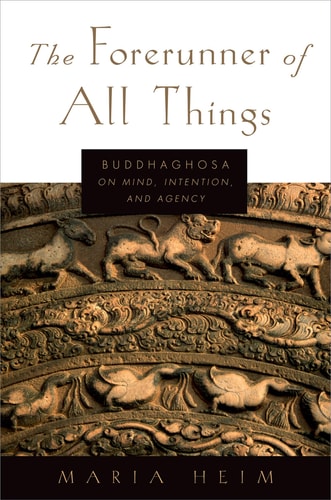
The Forerunner of All Things
0
0
As an Amazon Associate and affiliate partner, Menrva Books earns from qualifying purchases. Learn more
Author Description
Scholars have long been intrigued by the Buddha's defining action (karma) as intention. This book explores systematically how intention and agency were interpreted in all genres of early Theravada thought. It offers a philosophical exploration of intention and motivation as they are investigated in Buddhist moral psychology. At stake is how we understand karma, the nature of moral experience, and the possibilities for freedom.In contrast to many studies that assimilate Buddhist moral thinking to Western theories of ethics, the book attends to distinctively Buddhist ways of systematizing and theorizing their own categories. Arguing that meaning is a product of the explanatory systems used to explore it, the book pays particular attention to genre and to the 5th-century commentator Buddhaghosa's guidance on how to read Buddhist texts. The book treats all branches of the Pali canon (the Tipitaka, that is, the Suttas, the Abhidhamma, and the Vinaya), as well as narrative sources (the Dhammapada and the Jataka commentaries). In this sense it offers a comprehensive treatment of intention in the canonical Theravada sources. But the book goes further than this by focusing explicitly on the body of commentarial thought represented by Buddhaghosa. His work is at the center of the book's investigations, both insofar as he offers interpretative strategies for reading canonical texts, but also as he advances particular understandings of agency and moral psychology. The book offers the first book-length study devoted to Buddhaghosa's thought on ethics
Menrva's Summary
THE THESIS
This book investigates the foundational role of intention (cetana) in Buddhist moral psychology and its implications for understanding karma and human agency. Maria Heim, a scholar of South Asian religions, utilizes a rigorous analysis of early Theravada texts to challenge Western-centric interpretations of Buddhist ethics. By focusing on the 5th-century commentator Buddhaghosa, she reconstructs the internal logic and systematic frameworks that early Buddhist thinkers employed to theorize moral experience and the potential for liberation.
THE SCOPE MAP
What You Will Find
- Comprehensive analysis of the Pali canon, including the Suttas, Abhidhamma, and Vinaya.
- Examination of narrative sources such as the Dhammapada and Jataka commentaries.
- Methodological focus on Buddhaghosa’s interpretative strategies for reading canonical texts.
- Philosophical exploration of agency, motivation, and the mechanics of karma.
THE AUTHORITY PERSPECTIVE
Scholars recognize this work as a foundational study in the field of Buddhist ethics, particularly for its dedicated focus on Buddhaghosa’s commentarial contributions. Readers frequently note the academic density of the prose, which is tailored for those with a background in religious studies or philosophy.
Page Count:
260
Publication Date:
2013-01-01
Publisher:
Oxford University Press, Usa
ISBN-10:
0199331049
ISBN-13:
9780199331048
Philosophy
Religion
Ethics
Karma
Buddhism
Community Tags
Similar Books