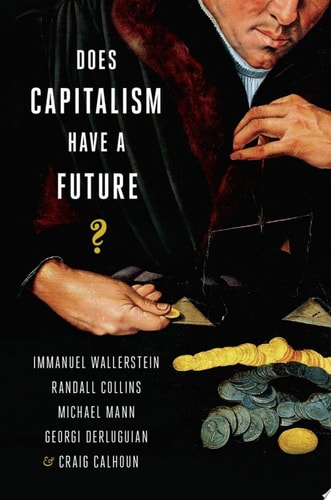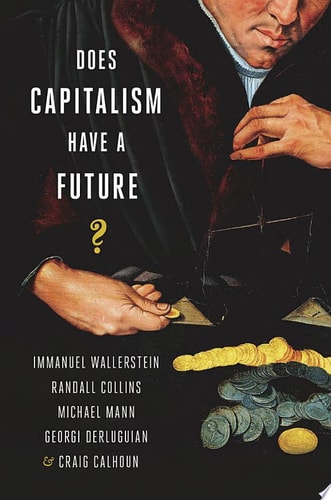
Does Capitalism Have a Future?
0
0
As an Amazon Associate and affiliate partner, Menrva Books earns from qualifying purchases. Learn more
Author Description
In Does Capitalism Have a Future?, a global quintet of distinguished scholars cut their way through to the question of whether our capitalist system can survive in the medium run. Despite the current gloom, conventional wisdom still assumes that there is no real alternative to capitalism. The authors argue that this generalization is a mistaken outgrowth of the optimistic nineteenth-century claim that human history ascends through stages to an enlightened equilibrium of liberal capitalism. All major historical systems have broken down in the end, and in the modern epoch several cataclysmic events-notably the French revolution, World War I, and the collapse of the Soviet bloc-came to pass when contemporary political elites failed to calculate the consequences of the processes they presumed to govern. At present, none of our governing elites and very few intellectuals can fathom a systemic collapse in the coming decades. While the book's contributors arrive at different conclusions, they are in constant dialogue with one another, and they construct a relatively seamless-if open-ended-whole.Written by five of world's most respected scholars of global historical trends, this ambitious book asks the most important of questions: are we on the cusp of a radical world historical shift?
Menrva's Summary
THE THESIS
This book investigates whether the current global capitalist system possesses the structural integrity to survive the coming decades or if it is approaching a systemic collapse. The authors, a group of distinguished scholars including Immanuel Wallerstein and Michael Mann, utilize historical sociology and long-term trend analysis to challenge the assumption that capitalism is the final, inevitable stage of human development. By examining past cataclysmic shifts—such as the French Revolution and the collapse of the Soviet bloc—the contributors argue that political elites frequently miscalculate the trajectory of the systems they govern, leading to unforeseen systemic failures.
THE SCOPE MAP
What You Will Find
- Historical analysis of systemic breakdowns including the French Revolution and World War I.
- Comparative sociological frameworks regarding the evolution of modern political and economic systems.
- Collaborative dialogue between five experts on global historical trends.
- Theoretical projections concerning the potential for radical world-historical shifts in the near future.
THE AUTHORITY PERSPECTIVE
Experts recognize this work as a significant contribution to macro-sociological discourse, noting that the authors provide a rigorous, multi-faceted critique of contemporary economic assumptions. Readers frequently highlight the academic density of the prose, which demands a foundational understanding of historical and political theory to fully grasp the authors' arguments.
Page Count:
208
Publication Date:
2013-11-18
Publisher:
Oxford University Press
ISBN-10:
0199330840
ISBN-13:
9780199330843
History
Economics
Sociology
Globalization
Middle class