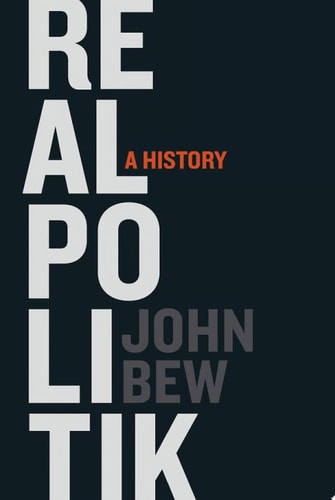
Realpolitik: A History
0
0
As an Amazon Associate and affiliate partner, Menrva Books earns from qualifying purchases. Learn more
Author Description
Realpolitik is approaching its 160th birthday, though it has existed as a form of statecraft for centuries and is arguably as old as the conduct of foreign affairs itself. Associated with great thinkers from Machiavelli to Kissinger, it is deeply rooted in the history of diplomacy yet also remains strikingly relevant to debates on contemporary foreign policy in the Obama administration today. Despite the fact that Realpolitik has had something of a renaissance in recent years, however, it remains a surprisingly elusive notion, defying easy categorization. In this concise book, John Bew aims to address this gap, offering a history of the concept of Realpolitik in the English-speaking world: its origins as an idea; its practical application to statecraft in the recent past; and its relevance to the foreign policy challenges facing the United States and its allies in the future. Now most often associated with the conduct of foreign policy, Realpolitik has traditionally had pejorative connotations in the English-speaking world and sits uneasily alongside notions of "enlightenment," "morality" and "virtue." But it has also had its defenders, admirers and exponents, who regard it as the best tool for the successful wielding of political power and the preservation of global order. As such, Realpolitik has both successes and failures to its name, as Bew's comprehensive and even-handed overview displays. Bew begins by charting the evolution of the idea through the work of important thinkers or statesmen from Machiavelli, Cardinal de Richelieu, and Thomas Hobbes up through Carl Schmitt, Kissinger, and Dennis Ross. He then examines how Realpolitik has been evoked and operationalized in US and UK foreign policy during specific episodes in the twentieth century, looking at such cases as the overthrow of Iranian Prime Minister Mohammad Mosaddegh in 1953, and President Nixon's visit to the People's Republic of China in 1972 - often taken as the archetypal instance of Realpolitik
Menrva's Summary
THE THESIS
This book investigates the historical evolution, conceptual ambiguity, and practical application of Realpolitik within the English-speaking world. John Bew, a historian and foreign policy expert, examines how this often-misunderstood form of statecraft has transitioned from a pejorative term to a central pillar of modern international relations. By analyzing the intellectual lineage of the concept and its implementation in specific geopolitical crises, the author provides a framework for understanding how power is wielded to maintain global order.
THE SCOPE MAP
What You Will Find
- A chronological analysis of political thought from Machiavelli and Richelieu to Carl Schmitt and Henry Kissinger.
- Examination of specific historical case studies, including the 1953 Iranian coup and the 1972 Nixon visit to China.
- An exploration of the tension between Realpolitik and moral or enlightenment-based approaches to foreign policy.
- A critical assessment of the successes and failures of realist statecraft in the twentieth century.
THE AUTHORITY PERSPECTIVE
Experts and historians frequently cite this work as a definitive, even-handed account that clarifies a notoriously elusive political concept. Readers often note the clarity of the prose, which successfully navigates complex diplomatic history for both academic and general audiences.
Page Count:
395
Publication Date:
2016-01-01
Publisher:
Oxford University Press,
ISBN-10:
0199331944
ISBN-13:
9780199331949
History
Biography
Philosophy
Diplomacy
Realism
International relations
Political Aspects
Community Tags
Similar Books