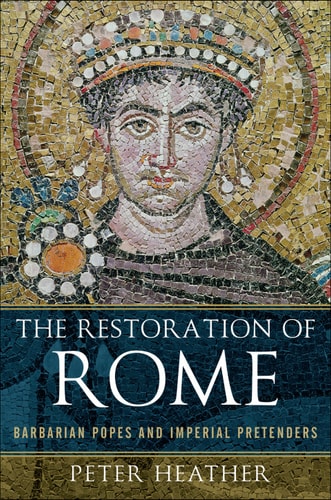
The Restoration of Rome: Barbarian Popes and Imperial Pretenders
0
0
As an Amazon Associate and affiliate partner, Menrva Books earns from qualifying purchases. Learn more
Author Description
In 476 AD, the last of Rome's emperors, known as "Augustulus," was deposed by a barbarian general, the son of one of Attila the Hun's henchmen. With the imperial vestments dispatched to Constantinople, the curtain fell on the Roman empire in Western Europe, its territories divided among successor kingdoms constructed around barbarian military manpower. But, if the Roman Empire was dead, Romans across much of the old empire still lived, holding on to their lands, their values, and their institutions. The conquering barbarians, responding to Rome's continuing psychological dominance and the practical value of many of its institutions, were ready to reignite the imperial flame and enjoy the benefits. As Peter Heather shows in dazzling biographical portraits, each of the three greatest immediate contenders for imperial power--Theoderic, Justinian, and Charlemagne--operated with a different power base but was astonishingly successful in his own way. Though each in turn managed to put back together enough of the old Roman West to stake a plausible claim to the Western imperial title, none of their empires long outlived their founders' deaths. Not until the reinvention of the papacy in the eleventh century would Europe's barbarians find the means to establish a new kind of Roman Empire, one that has lasted a thousand years.A sequel to the bestselling Fall of the Roman Empire, The Restoration of Rome offers a captivating narrative of the death of an era and the birth of the Catholic Church.
Menrva's Summary
THE THESIS
This work investigates how the collapse of the Western Roman Empire in the fifth century transitioned into a series of attempts to restore imperial authority through the figures of Theoderic, Justinian, and Charlemagne, ultimately culminating in the rise of the medieval papacy. Peter Heather, a distinguished historian of late antiquity, utilizes primary source analysis and biographical synthesis to argue that the Roman legacy persisted not through the survival of the state, but through the strategic appropriation of Roman institutions by barbarian successor kingdoms. He examines the political and psychological mechanisms that allowed these leaders to claim the mantle of Rome, despite the inherent instability of their short-lived imperial projects.
THE SCOPE MAP
What You Will Find
- Analysis of the political transition from the deposition of Romulus Augustulus in 476 AD to the eleventh-century papacy.
- Biographical case studies of Theoderic the Great, Justinian I, and Charlemagne.
- Examination of the integration of barbarian military power with Roman administrative and religious structures.
- Historical evidence regarding the psychological and practical influence of the Roman imperial title on post-Roman European rulers.
THE AUTHORITY PERSPECTIVE
Historians and scholars of late antiquity frequently cite this text for its accessible narrative style and its clear synthesis of complex political shifts during the early Middle Ages. Readers often note that the book provides a balanced perspective on the continuity of Roman institutions, making it a valuable resource for those interested in the transition from antiquity to the medieval period.
Page Count:
505
Publication Date:
2014-01-01
Publisher:
Oxford University Press
ISBN-10:
0199368538
ISBN-13:
9780199368532
Biography
History
European History
Europe
Papacy history
Catholic Church
Political History
Ancient History
Community Tags
Similar Books