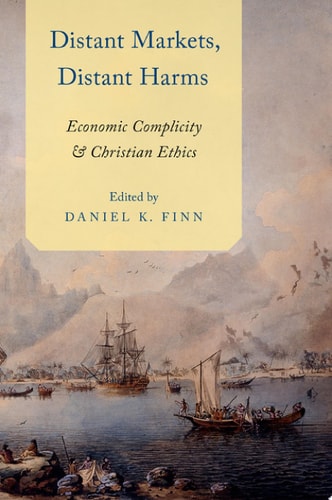
Distant Markets, Distant Harms: Economic Complicity and Christian Ethics
0
0
As an Amazon Associate and affiliate partner, Menrva Books earns from qualifying purchases. Learn more
Author Description
Does a consumer who bought a shirt made in another nation bear any moral responsibility when the women who sewed that shirt die in a factory fire or in the collapse of the building? Many have asserted, without explanation, that because markets cause harms to distant others, consumers bear moral responsibility for those harms. But traditional moral analysis of individual decisions is unable to sustain this argument.Distant Harms, Distant Markets presents a careful analysis of moral complicity in markets, employing resources from sociology, Christian history, feminism, legal theory, and Catholic moral theology today.Because of its individualistic methods, mainstream economics as a discipline is not equipped to understand the causality entailed in the long chains of social relationships that make up the market. Critical realist sociology, however, has addressed the character and functioning of social structures, an analysis that can helpfully be applied to the market. The True Wealth of Nations research project of the Institute for Advanced Catholic Studies brought together an international group of sociologists, economists, moral theologians, and others to describe these causal relationships and articulate how Catholic social thought can use these insights to more fully address issues of economic ethics in the twenty-first century. The result was this interdisciplinary volume of essays, which explores the causal and moral responsibilities that consumers bear for the harms that markets cause to distant others.
Menrva's Summary
THE THESIS
This volume investigates whether individual consumers bear moral responsibility for harms inflicted upon distant workers within complex, globalized market structures. Daniel K. Finn, a scholar of economics and theology, synthesizes insights from sociology, legal theory, and Catholic moral tradition to challenge the limitations of mainstream economic analysis. By moving beyond individualistic frameworks, the book argues that social structures create causal chains that necessitate a more nuanced understanding of economic complicity in the twenty-first century.
THE SCOPE MAP
What You Will Find
- An interdisciplinary analysis of causal relationships within global supply chains.
- Applications of critical realist sociology to the study of market structures.
- Integration of Catholic social thought with contemporary economic theory.
- Examination of moral responsibility in the context of consumer behavior and industrial disasters.
THE AUTHORITY PERSPECTIVE
Experts recognize this work as a significant contribution to the intersection of moral theology and economic ethics. Scholars frequently note the text's ability to bridge the gap between abstract moral philosophy and the practical realities of globalized labor markets.
Page Count:
288
Publication Date:
2014-01-01
Publisher:
Oxford University Press
ISBN-10:
0199371016
ISBN-13:
9780199371013
Economics
Religion
Christian ethics
Business Ethics
Moral theology
Macroeconomic Theory
Catholic Social Teaching
Sociology
Community Tags
Similar Books