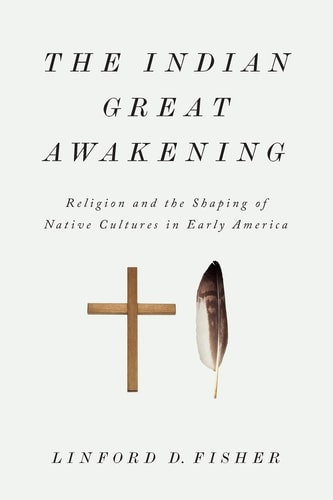
The Indian Great Awakening: Religion and the Shaping of Native Cultures in Early America
0
0
As an Amazon Associate and affiliate partner, Menrva Books earns from qualifying purchases. Learn more
Author Description
The First Great Awakening was a time of heightened religious activity in the colonial New England. Among those whom the English settlers tried to convert to Christianity were the region's native peoples. In this book, Linford Fisher tells the gripping story of American Indians' attempts to wrestle with the ongoing realities of colonialism between the 1670s and 1820. In particular, he looks at how some members of previously unevangelized Indian communities in Connecticut, Rhode Island, western Massachusetts, and Long Island adopted Christian practices, often joining local Congregational churches and receiving baptism. Far from passively sliding into the cultural and physical landscape after King Philip's War, he argues, Native individuals and communities actively tapped into transatlantic structures of power to protect their land rights, welcomed educational opportunities for their children, and joined local white churches. Religion repeatedly stood at the center of these points of cultural engagement, often in hotly contested ways. Although these Native groups had successfully resisted evangelization in the seventeenth century, by the eighteenth century they showed an increasing interest in education and religion. Their sporadic participation in the First Great Awakening marked a continuation of prior forms of cultural engagement. More surprisingly, however, in the decades after the Awakening, Native individuals and sub-groups asserted their religious and cultural autonomy to even greater degrees by leaving English churches and forming their own Indian Separate churches. In the realm of education, too, Natives increasingly took control, preferring local reservation schools and demanding Indian teachers whenever possible. In the 1780s, two small groups of Christian Indians moved to New York and founded new Christian Indian settlements. But the majority of New England Natives-even those who affiliated with Christianity-chose to remain in New England, continuing to ass
Menrva's Summary
THE THESIS
This book investigates how Native American communities in colonial New England navigated the pressures of the First Great Awakening to assert cultural and religious autonomy. Linford D. Fisher, a scholar of early American history, utilizes a wide array of primary sources to challenge the narrative that indigenous populations were passive recipients of colonial religious influence. By examining the period between 1670 and 1820, Fisher argues that Native individuals strategically engaged with Christianity and educational systems to protect land rights and maintain community cohesion.
THE SCOPE MAP
What You Will Find
- Analysis of Native American engagement with Congregational churches in Connecticut, Rhode Island, Massachusetts, and Long Island.
- Examination of the transition from colonial evangelization to the formation of independent Indian Separate churches.
- Evaluation of how indigenous groups utilized transatlantic power structures to secure educational and territorial interests.
- Case studies of specific Native communities that resisted total assimilation while adopting selective Christian practices.
THE AUTHORITY PERSPECTIVE
Historians recognize this work as a significant contribution to the study of indigenous agency within the context of colonial religious history. Scholars frequently cite the text for its nuanced approach to the intersection of power, religion, and cultural survival in early America.
Page Count:
312
Publication Date:
2014-04-07
Publisher:
Oxford University Press
ISBN-10:
0199376441
ISBN-13:
9780199376445
History
Religion
New England
Christianity and other religions
Christianity And Culture
Sociology
History of the Americas
Colonial History
North America
Community Tags
Other Editions(2)
Similar Books










Reader Comments
Share Your Thoughts
No comments yet. Be the first to share your thoughts!