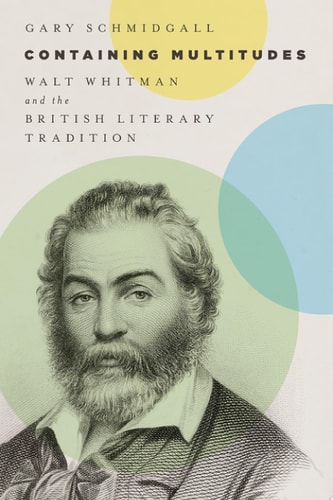
Containing Multitudes: Walt Whitman and the British Literary Tradition
0
0
As an Amazon Associate and affiliate partner, Menrva Books earns from qualifying purchases. Learn more
Author Description
Walt Whitman burst onto the literary stage raring for a fight with his transatlantic forebears. With the unmetered and unrhymed long lines of Leaves of Grass, he blithely forsook "the old models" declaring that "poems distilled from other poems will probably pass away." In a self-authored but unsigned review of the inaugural 1855 edition, Whitman boasted that its influence-free author "makes no allusions to books or writers; their spirits do not seem to have touched him." There was more than a hint here of a party-crasher's bravado or a new-comer's anxiety about being perceived as derivative. But the giants of British literature were too well established in America to be toppled by Whitman's patronizing "that wonderful little island," he called England-or his frequent assertions that Old World literature was non grata on American soil. As Gary Schmidgall demonstrates, the American bard's manuscripts, letters, prose criticism, and private conversations all reveal that Whitman's negotiation with the literary "big fellows" across the Atlantic was much more nuanced and contradictory than might be supposed. His hostile posture also changed over the decades as the gymnastic rebel transformed into Good Gray Poet, though even late in life he could still crow that his masterwork Leaves of Grass "is an iconoclasm, it starts out to shatter the idols of porcelain." Containing Multitudes explores Whitman's often uneasy embrace of five members of the British literary pantheon: Shakespeare, Milton, Burns, Blake, and Wordsworth (five others are treated more briefly: Scott, Carlyle, Tennyson, Wilde, and Swinburne). It also considers how the arcs of their creative careers are often similar to the arc of Whitman's own fifty years of poem-making. Finally, it seeks to illuminate the sometimes striking affinities between the views of these authors and Whitman on human nature and society. Though he was loath to admit it, these authors anticipated much that we now see as quintessentially W
Menrva's Summary
THE THESIS
This work investigates the complex, often contradictory relationship between Walt Whitman and the established British literary tradition he publicly claimed to reject. Author Gary Schmidgall, a scholar of Whitman’s life and work, utilizes a broad range of primary sources including manuscripts, private correspondence, and prose criticism to challenge the poet's own narrative of independence. By analyzing these documents, Schmidgall argues that Whitman’s creative development was deeply informed by, rather than isolated from, the influence of the British literary canon.
THE SCOPE MAP
What You Will Find
- Detailed analysis of Whitman's engagement with five primary British figures: Shakespeare, Milton, Burns, Blake, and Wordsworth.
- Comparative studies of creative career arcs between Whitman and his transatlantic predecessors.
- Examination of secondary influences including Scott, Carlyle, Tennyson, Wilde, and Swinburne.
- A thematic exploration of shared views on human nature and societal structures across disparate literary traditions.
THE AUTHORITY PERSPECTIVE
Scholars and critics recognize this text as a significant contribution to Whitman studies, particularly for its meticulous use of archival evidence to dismantle the myth of the poet's total isolation. Readers frequently note the academic density of the prose, which provides a rigorous framework for understanding the evolution of Whitman's public persona versus his private intellectual life.
Page Count:
400
Publication Date:
2014-01-01
Publisher:
Oxford University Press
ISBN-10:
0199374422
ISBN-13:
9780199374427
Poetry
Biography
History
English
Influence Literary artistic etc
English & College Success
Literary Criticism
American
Community Tags
Similar Books