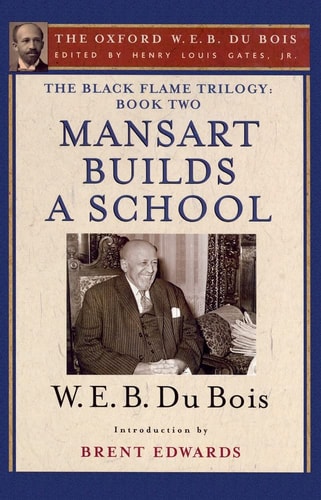
Mansart Builds a School
0
0
As an Amazon Associate and affiliate partner, Menrva Books earns from qualifying purchases. Learn more
Author Description
W. E. B. Du Bois was a public intellectual, sociologist, and activist on behalf of the African American community. He profoundly shaped black political culture in the United States through his founding role in the NAACP, as well as internationally through the Pan-African movement. Du Bois's sociological and historical research on African-American communities and culture broke ground in many areas, including the history of the post-Civil War Reconstruction period. Du Bois was also a prolific author of novels, autobiographical accounts, innumerable editorials and journalistic pieces, and several works of history.Du Bois called his epic Black Flame trilogy a fiction of interpretation. It acts as a representative biography of African American history by following one man, Manuel Mansart, from his birth in 1876 until his death. The Black Flame attempts to use this historical fiction of interpretation to recast and revisit the African American experience. Readers will appreciate The Black Flame trilogy as a clear articulation of Du Bois's perspective at the end of his life.The second book in this profound trilogy, Mansart Builds a School, opens with Mansart's election to superintendent of Negro schools in Atlanta and follows him as he ascends to the position of president of Georgia State A&M College. The book provides a damning portrait of the state of education for African Americans in the south. Building upon the drama and intrigue of The Ordeal of Mansart in Du Bois's signature lyrical style, Mansart Builds a School delves into the realities of the ordinary southern black experience of the early twentieth century. With a series introduction by editor Henry Louis Gates, Jr., and an introduction by Brent Hayes Edwards, this edition is essential for anyone interested in African American literature.
Menrva's Summary
THE PULSE
Manuel Mansart faces the systemic challenges of the Jim Crow South as he attempts to reform and expand educational opportunities for African American students. As the newly elected superintendent of Negro schools in Atlanta, Mansart navigates a landscape defined by racial segregation, political corruption, and limited resources. His objective to elevate the quality of education for his community is constantly obstructed by white supremacist power structures and the internal politics of the academic institutions he serves. The narrative follows his ascent to the presidency of Georgia State A&M College, documenting the logical constraints of a society designed to suppress black intellectual advancement. Du Bois employs a third-person perspective to weave historical reality with the fictionalized life of his protagonist, creating a dense, analytical narrative framework.
INSIDE THE PAGES
- Detailed examination of the Jim Crow era educational system in the American South
- Exploration of the intersection between political power and academic administration
- Lyrical prose style characteristic of Du Bois's later literary output
- Integration of historical figures and events into a fictionalized biography
- Critical analysis of the socio-economic conditions facing African Americans in the early twentieth century
- Focus on the institutional barriers to black intellectual and professional development
- Character-driven narrative centered on the professional life of Manuel Mansart
- Thematic focus on the role of education as a tool for social and political liberation
THE COLLECTIVE ECHO
Readers and critics frequently identify this work as a vital piece of political fiction that functions as a sociological study of the post-Reconstruction South. Discussion often centers on the balance between the protagonist's personal development and the broader historical context that Du Bois aims to document. Many highlight the effectiveness of the author's prose in capturing the atmosphere of institutional struggle and the complexities of navigating a hostile political environment. The work is often analyzed for its clear articulation of Du Bois's late-life perspectives on race, education, and the future of the African American experience. Readers interested in the intersection of history and literature find the narrative provides a rigorous look at the systemic obstacles of the era.
Page Count:
330
Publication Date:
2014-03-01
Publisher:
Oxford University Press
ISBN-10:
0199386994
ISBN-13:
9780199386994
Historical Fiction
African American
Social Commentary
Political fiction
African Americans