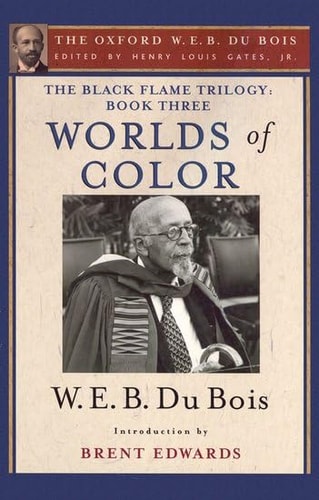
Worlds of Color
0
0
As an Amazon Associate and affiliate partner, Menrva Books earns from qualifying purchases. Learn more
Author Description
W. E. B. Du Bois was a public intellectual, sociologist, and activist on behalf of the African American community. He profoundly shaped black political culture in the United States through his founding role in the NAACP, as well as internationally through the Pan-African movement. Du Bois's sociological and historical research on African-American communities and culture broke ground in many areas, including the history of the post-Civil War Reconstruction period. Du Bois was also a prolific author of novels, autobiographical accounts, innumerable editorials and journalistic pieces, and several works of history.Du Bois called his epic Black Flame trilogy a fiction of interpretation. It acts as a representative biography of African American history by following one man, Manuel Mansart, from his birth in 1876 until his death. The Black Flame attempts to use this historical fiction of interpretation to recast and revisit the African American experience. Readers will appreciate The Black Flame trilogy as a clear articulation of Du Bois's perspective at the end of his life.The last book in this profound trilogy, Worlds of Color, opens when Mansart is sixty and a successful and established college president. Packed with political intrigue, romance, and social commentary, the book provides a dark, cynical view of the world and its relationship to the "Black Flame," or the potential of black civilization. Building upon the drama of the previous two books, Worlds of Color delves into a more sinister, bleak, and doubtful future. With a series introduction by editor Henry Louis Gates, Jr., and an introduction by Brent Hayes Edwards, this edition is essential for anyone interested in African American literature.
Menrva's Summary
THE PULSE
As Manuel Mansart reaches his sixties, he confronts the global complexities of race and power that threaten to extinguish the potential of black civilization. Following the life of Manuel Mansart from his birth in 1876, this final installment of the trilogy tracks his tenure as a college president amidst a shifting political landscape. The narrative functions as a fiction of interpretation, utilizing Mansart's personal trajectory to examine the broader historical currents of the twentieth century. The prose maintains a somber tone, reflecting the protagonist's aging perspective as he navigates international intrigue and domestic social upheaval. The story operates within a framework of historical realism, grounding its philosophical inquiries in the tangible experiences of its central character.
INSIDE THE PAGES
- Examination of the global African diaspora and its political struggles
- Detailed portrayal of the academic and social responsibilities of a college president
- Integration of historical events with fictionalized biographical elements
- Exploration of the cynicism surrounding the potential of black civilization
- Inclusion of political intrigue and romantic subplots
- Use of the protagonist as a vessel for the author's late-life reflections
- Analysis of the post-Civil War era and its long-term societal impacts
- Stylistic focus on social commentary and ideological debate
THE COLLECTIVE ECHO
Readers and critics often describe this work as a dense, philosophical conclusion to a significant historical project. Discussion frequently centers on the shift toward a more cynical and bleak outlook compared to the earlier volumes in the trilogy. Many highlight the effectiveness of the narrative in capturing the author's final perspectives on race and global politics. The balance between character development and ideological discourse remains a primary focus for those analyzing the text's historical significance. Scholars often note that the book serves as a vital document for understanding the intellectual evolution of its author during his later years.
Page Count:
302
Publication Date:
2014-03-01
Publisher:
Oxford University Press, USA
ISBN-10:
0199387265
ISBN-13:
9780199387267
History
Historical Fiction
Politics
Political fiction
Social Commentary
African American
Americas
Ethnic Studies
New Used & Rental Textbooks
Community Tags
Other Editions(2)
Similar Books