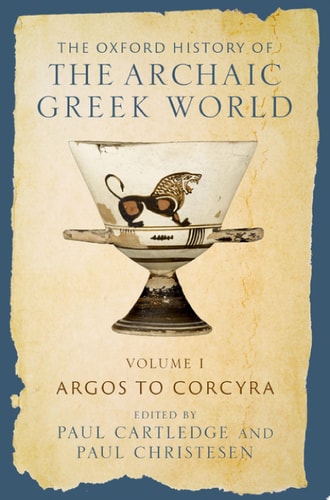
The Oxford History of the Archaic Greek World: Volume I: Argos to Corcyra
0
0
As an Amazon Associate and affiliate partner, Menrva Books earns from qualifying purchases. Learn more
Author Description
The ancient Greek world consisted of approximately 1,000 autonomous polities scattered across the Mediterranean basin and was remarkable for both its diversity and its uniformity. As Greeks dispersed throughout the Mediterranean, the different environmental and human ecosystems they encountered created important differences among widely scattered settlements: each Greek community developed its own unique set of socio-political institutions and social practices. Nonetheless, despite their dispersal and diversity, Greek communities were bound together by a network of commercial, cultural, diplomatic, and military ties and shared important commonalities, most notably language and religion.The Oxford History of the Archaic Greek World, a collaborative effort by more than forty eminent scholars, offers twenty-one detailed and comprehensive studies of key sites from across the Greek world in the period between c. 750 and c. 480 BCE. During that period, Greeks confronted a series of demographic, political, social, and economic challenges and generated an array of responses that transformed the ways in which they lived, worked, and interacted. Much of what is now seen as distinctive about Greek culture--such as democracy, stone temples, and nude athletics--first developed during the Archaic period.The series is organized alphabetically by polis. Volume I contains detailed and up-to-date studies of Argos, Chalcis and Eretria, Chios-Lesbos-Samos, and Corcyra. Together with the other volumes in the series, the Oxford History of the Archaic Greek World offers a new and unique resource for the study of ancient Greece that will transform how we understand a crucial era in antiquity.
Menrva's Summary
THE THESIS
This volume investigates how the diverse, autonomous polities of the Archaic Greek world navigated demographic, political, and economic challenges between 750 and 480 BCE. Robin Osborne and a team of over forty scholars utilize archaeological evidence and historical analysis to examine how these scattered communities developed unique socio-political institutions while maintaining shared cultural, religious, and commercial ties. The work argues that the foundational elements of Greek culture, including early democratic structures and monumental architecture, emerged as direct responses to these localized environmental and social pressures.
THE SCOPE MAP
What You Will Find
- Detailed site-specific studies of Argos, Chalcis, Eretria, Chios, Lesbos, Samos, and Corcyra.
- Analysis of the transition from early settlement patterns to the development of distinct polis identities.
- Examination of the role of trade networks, diplomacy, and military interaction in binding disparate Greek communities.
- Synthesis of archaeological data and primary source evidence regarding the origins of stone temples and athletic traditions.
THE AUTHORITY PERSPECTIVE
Experts recognize this series as a comprehensive, multi-volume reference that provides a granular look at the regional variations within the Archaic period. Readers frequently note the academic density of the prose, which serves as a foundational resource for students and researchers of classical antiquity.
Page Count:
632
Publication Date:
2024-01-01
Publisher:
Oxford University Press
ISBN-10:
0199383596
ISBN-13:
9780199383597
History
Politics
Schools & Teaching
Europe
Ancient History
Archaeology
Greece
Community Tags
Similar Books