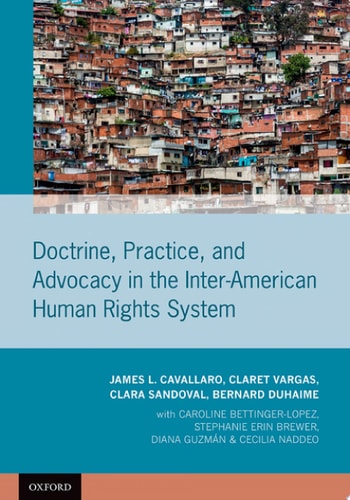
Doctrine, Practice, and Advocacy in the Inter-American Human Rights System
0
0
As an Amazon Associate and affiliate partner, Menrva Books earns from qualifying purchases. Learn more
Author Description
Doctrine, Practice and Advocacy in the Inter-American Human Rights System is the first casebook to focus on the Inter-American human rights system, the primary system for advancing and protecting rights in the Western hemisphere. Created by the Organization of American States, the Inter-American Commission on Human Rights and the Inter-American Court of Human Rights are autonomous and independent bodies that make up the Inter-American system. Together, they play a vital role, working closely with victims, civil society, and states to protect fundamental human rights in the Western hemisphere, particularly in Latin America. While the system is relatively unknown in legal academia in the United States and Canada, its study is mandatory in most law schools in the Americas. Government appointees, civil servants, high level actors, private attorneys, judges and legal scholars, and media regularly engage with the system in Latin America, implementing its determinations and applying its rulings and interpretations concerning the human rights of their citizens. Thus critical matters affecting vital rights, such as the peace process in Colombia, disappearances in Mexico, gang violence in the Northern Triangle (El Salvador, Honduras, and Guatemala) or trials for perpetrators of crimes against humanity in Argentina, all directly involve the rulings and actors of the Inter-American system. Increasingly, the Inter-American system has advanced rights protection in the United States and Canada. The statements and determinations of the Inter-American Commission on the detention center at Guantanamo, for example, led to a global consensus opposing the prolonged use of pretrial detention at that site, while the Commission's ruling on the juvenile death penalty was cited by the United States Supreme Court in its holding finding that practice unconstitutional. A report by the Commission on murdered and missing indigenous women in British Columbia led to the creation of a National Commi
Menrva's Summary
THE THESIS
This text investigates the operational mechanics, legal doctrines, and practical advocacy strategies utilized within the Inter-American Human Rights System to protect fundamental rights across the Western Hemisphere. The authors, a team of distinguished legal scholars and practitioners, provide a comprehensive framework for understanding how the Inter-American Commission on Human Rights and the Inter-American Court of Human Rights function as autonomous bodies. By synthesizing institutional history with contemporary case law, the book establishes a pedagogical foundation for students and professionals to navigate the system's complex legal landscape.
THE SCOPE MAP
What You Will Find
- Analysis of the institutional structure of the Organization of American States human rights bodies
- Case studies involving regional issues such as the Colombian peace process and disappearances in Mexico
- Methodologies for legal advocacy and the implementation of international rulings
- Examination of the system's influence on domestic law in the United States and Canada
Scope Limits
- The text focuses primarily on the Inter-American system and does not provide a comparative analysis of European or African human rights frameworks
- It is designed as a legal casebook rather than a general historical narrative of Latin American politics
THE AUTHORITY PERSPECTIVE
Legal scholars and practitioners identify this work as a foundational casebook for understanding the regional human rights architecture in the Americas. Readers frequently note the academic rigor and the practical utility of the materials for those engaging with the Inter-American Commission and Court.
Page Count:
968
Publication Date:
2019-07-19
Publisher:
Oxford University Press
ISBN-10:
0190900865
ISBN-13:
9780190900861
Reference
International Law
Law
United States
Human rights
American Studies
Community Tags
Other Editions(3)
Similar Books





Reader Comments
Share Your Thoughts
No comments yet. Be the first to share your thoughts!