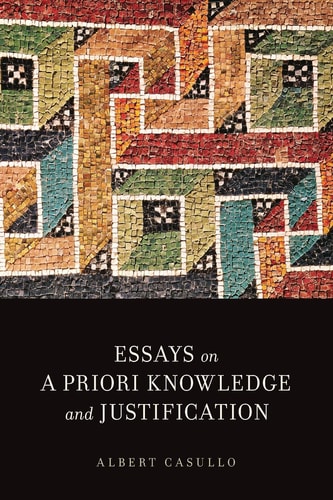
Essays on a Priori Knowledge and Justification
0
0
As an Amazon Associate and affiliate partner, Menrva Books earns from qualifying purchases. Learn more
Author Description
The past twenty-five years have seen a major renewal of interest in the topic of a priori knowledge. In the sixteen essays collected here, which span this entire period, philosopher Albert Casullo documents the complex set of issues motivating the renewed interest, identifies the central epistemological questions, and provides the leading ideas of a unified response to them. Throughout the essays, Casullo offers a systematic treatment of the concept of a priori knowledge, the existence of a priori knowledge, and the relationship between a priori knowledge and the related concepts of necessary truth and analytic truth. The essays fall into three categories: six published prior to his A Priori Justification (OUP, 2003), four published after the book, and four previously unpublished papers.The first six essays provide the background and introduction to a number of the major themes of the book: the articulation and defense of the minimal conception of a priori justification, an exposition of the limitations of the traditional arguments both for and against a priori knowledge, and the relevance of empirical investigation to providing supporting evidence for the claim that there are nonexperiential sources of justification.The remaining four published essays explore diverse themes that were introduced in Casullo's previous book but not developed in detail: epistemic overdetermination, the relationship between a priori knowledge and necessary truth, testimony and a priori knowledge, and the bearing of socio-historical accounts of knowledge on the a priori.The four previously unpublished essays address issues that have either emerged or taken on more prominence in the literature on the a priori since the publication of Casullo's previous book: the evidential status of intuitions, the nature of modal knowledge, and challenges to the cogency or the significance of the a priori-a posteriori distinction.
Menrva's Summary
THE THESIS
This collection investigates the conceptual foundations, validity, and epistemological significance of a priori knowledge within contemporary philosophical discourse. Albert Casullo, an established philosopher, synthesizes over two decades of research to address the central tensions surrounding non-experiential justification. By examining the interplay between necessary truth, analytic truth, and empirical evidence, Casullo constructs a systematic framework that evaluates both traditional arguments and modern challenges to the a priori-a posteriori distinction.
THE SCOPE MAP
What You Will Find
- A systematic defense of the minimal conception of a priori justification.
- Analysis of the relationship between a priori knowledge and necessary truth.
- Examination of the evidential status of intuitions and modal knowledge.
- Critical review of the relevance of socio-historical accounts to epistemological theory.
THE AUTHORITY PERSPECTIVE
Experts recognize this collection as a vital resource for those engaged in advanced epistemological study, particularly for its rigorous treatment of the a priori-a posteriori distinction. Readers frequently note the academic density of the prose, which assumes a high level of familiarity with analytic philosophy and formal logic.
Page Count:
384
Publication Date:
2014-07-01
Publisher:
Oxford University Press
ISBN-10:
0199395756
ISBN-13:
9780199395750
Philosophy
Non-Fiction
Epistemology
Logic
Community Tags
Other Editions(2)
Similar Books




Reader Comments
Share Your Thoughts
No comments yet. Be the first to share your thoughts!