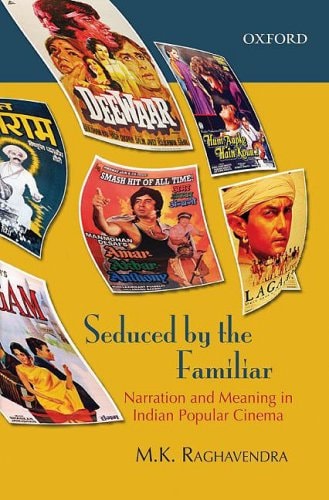
Seduced by the Familiar: Narration and Meaning in Indian Popular Cinema
0
0
As an Amazon Associate and affiliate partner, Menrva Books earns from qualifying purchases. Learn more
Author Description
Hindi popular cinema has played a key role as a national cinema because it assisted in the imagining of a unified India by addressing a public across the nation-to-be even before 1947. Examining the diverse elements that constitute the "popular" in Indian cinema, M.K. Raghavendra undertakes, in this book, a chronological study of films to speculate on narrative conventions, thematic continuities, myths, archetypes, and other formal structures that inform it from its hesitant beginnings up to the 1990s. A significant contribution to film studies, the book makes crucial connections between film motifs and other aspects of culture, exploring the development of film narrative using the social history of India as a continuing frame of reference.
Menrva's Summary
THE THESIS
This book investigates how Hindi popular cinema functioned as a primary vehicle for constructing a unified national identity in India through its unique narrative conventions and cultural motifs. M.K. Raghavendra, a noted film scholar, utilizes a chronological framework to analyze the evolution of Indian film from its inception through the 1990s. By situating cinematic development within the broader context of Indian social history, the author argues that popular films rely on specific archetypes and formal structures that reflect the nation's evolving political and cultural landscape.
THE SCOPE MAP
What You Will Find
- A chronological analysis of Hindi cinema from its early development to the 1990s.
- Examination of narrative conventions, myths, and archetypes prevalent in Indian film.
- Integration of social history as a primary frame of reference for cinematic interpretation.
- Exploration of the relationship between film motifs and broader Indian cultural identity.
THE AUTHORITY PERSPECTIVE
Scholars and film critics frequently cite this work as a foundational text for understanding the formal and thematic structures of Indian popular cinema. Readers often note the academic density of the prose, which provides a rigorous framework for analyzing the intersection of national history and film narrative.
Page Count:
376
Publication Date:
2015-07-01
Publisher:
Oxford University Press
ISBN-10:
0199456305
ISBN-13:
9780199456307
History
Kindle Store
Film Studies
Categories
Sociology
Kindle eBooks
Indian Cinema
Movies
Video photography
Motion pictures