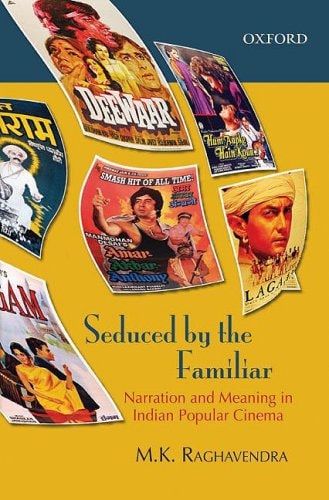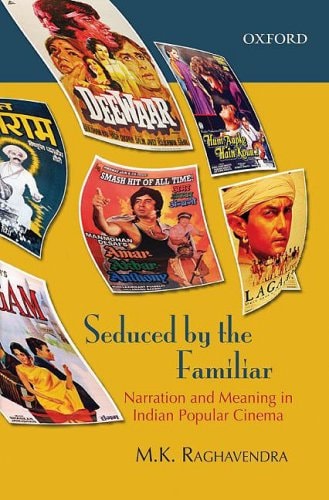
Seduced by the Familiar: Narration and Meaning in Indian Popular Cinema
0
0
As an Amazon Associate and affiliate partner, Menrva Books earns from qualifying purchases. Learn more
Author Description
The Hindi film industry has come to represent 'India' in the world today. Drawing from this 'globalization' of 'Bollywood', Seduced by the Familiar is a contemporary take on Indian cinema as represented by Hindi films. The author, M.K. Raghavendra, an award-winning film critic and scholar, makes a case for the 'surface' reading of Hindi films, in contrast to the rather disparaging view that critics, and sometimes practitioners, have traditionally taken of 'popular' cinema.The book traces the main themes of Hindi cinema chronologically from before 1947 up to contemporary times. Beginning with 'primitive cinema' such as Raja Harishchandra (1913), Raghavendra traces the trajectory of Hindi cinema from Baazi (1951) to Mother India (1957), Yaadon ki Baarat (1973), Sholay (1975), Qayamat Se Qayamat Tak(1988), and Hum Aapke Hain Koun!(1994), right on till the recent Kabhi Alvida na Kehna (2006). He studies the thematic continuities, myths, archetypes, and formal structures of this body of cinema and analyses the legitimacy and enduring popularity of Hindi cinema vis-a-vis the history of the Indian nation.In addition, Seducing the Familiar includes an Introduction specifying the book's theoretical underpinnings, and a detailed chapter on narrative forms and conventions in Hindi cinema such as melodrama. Providing a lucid and sympathetic view of Hindi 'popular' cinema, Seducing the Familiar is an accessible study that will interest students and researchers of cultural and film studies, sociology, and history, as well as general readers interested in the phenomenon of 'Bollywood'.
Menrva's Summary
THE THESIS
Does the enduring popularity of Hindi cinema reflect a coherent set of national myths and formal structures that critics have historically overlooked? M.K. Raghavendra, an award-winning film critic and scholar, argues for a 'surface' reading of popular Hindi films to uncover their internal logic and cultural significance. By examining the industry's evolution from the early twentieth century to the mid-2000s, the author challenges disparaging academic views and establishes a framework for understanding these films as legitimate cultural artifacts.
THE SCOPE MAP
What You Will Find
- A chronological analysis of Hindi cinema from the silent era to 2006.
- Examination of key films including Raja Harishchandra, Mother India, Sholay, and Kabhi Alvida na Kehna.
- A detailed study of narrative conventions such as melodrama and archetypal storytelling.
- An exploration of thematic continuities and their relationship to the history of the Indian nation.
THE AUTHORITY PERSPECTIVE
Scholars and students of cultural studies frequently cite this work as a foundational text for understanding the formal structures of Bollywood. Experts highlight the author's ability to bridge the gap between academic film theory and accessible analysis for the general reader.
Page Count:
382
Publication Date:
2015-07-12
Publisher:
Oxford University Press
ISBN-10:
0195696549
ISBN-13:
9780195696547
History
Non-Fiction
Film Studies
Motion pictures
Sociology