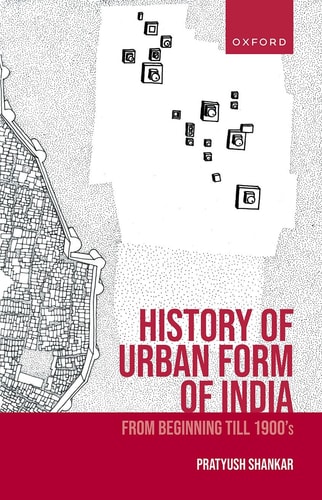
History of Urban Form of India: From Beginning till 1900s
0
0
As an Amazon Associate and affiliate partner, Menrva Books earns from qualifying purchases. Learn more
Author Description
India, like many other developing countries today, is undergoing massive urbanization. The imagination of the future form of Indian cities in terms of urban planning and design is most urgent. A study of the key historical moments in the country from the point of view of urban development, thus, becomes all the more important. This book presents a comprehensive account of the historical spatial development of Indian cities since time immemorial. With case studies from the time cities originated in the Indian subcontinent (3000 B.C in Indus valley) and hand-drawn illustrations of these cities till the ones in recent times, the author discusses the last two hundred years of urban development in India with emphasis on the overall structure of the city, its nature of public places, institutions, and housing. The book is ideal for readers curious about the material history of cities; what form of cities existed in the past, and how did it change with time or with other political events. How were cities, public places, and housing organized then and why do South Asian cities seem to show a distinct form and texture? By understanding historical precedents and layers that influence urbanism in the region, the book offers theoretical constructs that will allow us to understand better the contemporary cities of the region.
Menrva's Summary
THE THESIS
This book investigates the historical evolution of urban spatial development in India to provide a theoretical framework for understanding the contemporary form of South Asian cities. Professor Pratyush Shankar utilizes his expertise in urban design to trace the trajectory of Indian urbanization from the Indus Valley civilization through the early 20th century. By analyzing the structural shifts in public spaces, institutions, and housing, the author argues that historical precedents are essential for conceptualizing the future of rapidly growing urban environments in the region.
THE SCOPE MAP
What You Will Find
- Historical analysis of urban development from 3000 B.C. to the 1900s.
- Detailed case studies of ancient and colonial-era city structures.
- Original hand-drawn illustrations documenting spatial evolution.
- Theoretical constructs regarding the organization of public places and housing.
THE AUTHORITY PERSPECTIVE
Experts and urban planners recognize this work as a significant contribution to the material history of South Asian urbanism. Readers frequently note the clarity provided by the author's hand-drawn illustrations in visualizing complex historical spatial changes.
Page Count:
304
Publication Date:
2024-01-01
Publisher:
Oxford University Press
ISBN-10:
0199468095
ISBN-13:
9780199468096
History
Architecture
India
urban planning
Social Science
Community Tags
Similar Books