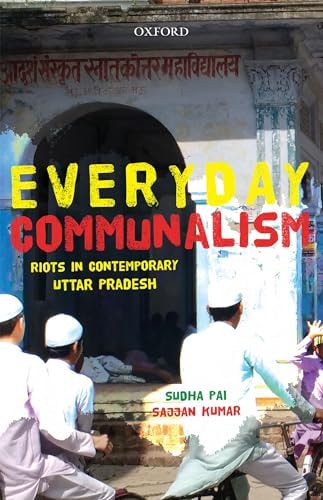
Everyday Communalism: Riots in Contemporary Uttar Pradesh
0
0
As an Amazon Associate and affiliate partner, Menrva Books earns from qualifying purchases. Learn more
Author Description
With the demolition of the Babri Masjid and subsequent riots of the late 1980s and 1990s in Uttar Pradesh, the period that followed appeared relatively peaceful. Only at the turn of the century, India witnessed a strong wave of communalism in early 2000s. After the Godhra riots of Gujarat in 2002, Uttar Pradesh saw a series of them--in Mau in 2005, Lucknow in 2006, Gorakhpur in 2007, and Muzaffarnagar in 2013--announcing the return of fundamentalism in the Bharatiya Janta Party's core agenda of Hindutva politics.Everyday Communalism not only attempts to explore the anatomy of a Hindu-Muslim riot and its aftermath, but also examines the inner workings that enable deep-seated polarization between communities. Pai and Kumar show that frequent, low-intensity communal clashes pegged on routine everyday issues and resources help establish a permanent anti-Muslim prejudice among Hindus legitimizing majoritarian rule in the eyes of an increasingly polarized, intolerant, and entitled majority community of Hindus. Uttar Pradesh's rising cultural aspirations; economic anxieties to move away from its traditionally backward status; a deep caste-marked agrarian crisis; and sharp inequalities and acute poverty further play into the making a new post-Ayodhya phase of Hindutva politics.
Menrva's Summary
THE THESIS
This book investigates how frequent, low-intensity communal clashes in Uttar Pradesh serve to institutionalize anti-Muslim prejudice and legitimize majoritarian political agendas. Authors Sajjan Kumar and Sudha Pai utilize a combination of political analysis and sociological observation to argue that communalism has evolved from sporadic, high-profile events into a routine, everyday phenomenon. They examine how economic anxieties, caste dynamics, and cultural aspirations in post-Ayodhya Uttar Pradesh create a fertile environment for the normalization of Hindutva politics.
THE SCOPE MAP
What You Will Find
- Analysis of specific communal riots in Mau, Lucknow, Gorakhpur, and Muzaffarnagar.
- Examination of the intersection between agrarian crisis, poverty, and communal polarization.
- Evaluation of the Bharatiya Janta Party's political strategy regarding Hindutva.
- Theoretical framework explaining the transition from high-intensity riots to everyday communal friction.
THE AUTHORITY PERSPECTIVE
Experts recognize this work as a significant contribution to the study of contemporary Indian politics and the mechanics of communal polarization. Readers frequently note the analytical depth with which the authors connect local socio-economic conditions to broader national political trends.
Page Count:
368
Publication Date:
2018-01-01
Publisher:
Oxford University Press
ISBN-10:
0199466297
ISBN-13:
9780199466290
History
Religion
Sociology
India
Social Issues
Riots
Muslims india
Community Tags
Similar Books