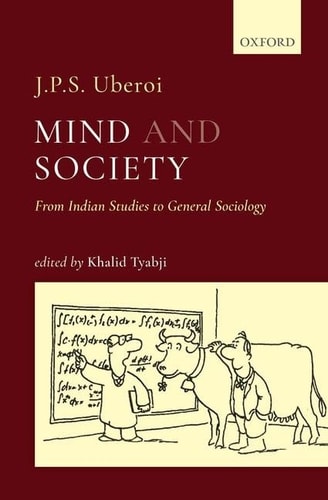
Mind and Society: From Indian Studies to General Sociology
0
0
As an Amazon Associate and affiliate partner, Menrva Books earns from qualifying purchases. Learn more
Author Description
A book much needed by India, Indian sociology and the Indian sense of self. This is a strikingly bold volume, diverse in content and yet united by its search for what might be called a truly Indian modernity in the sense of the Gandhian swaraj of mind. A swaraj unfettered by the history of colonialism and the continuing domination of the post-colonial West in both approach and choice of subject matter in Indian academics which continues to define contemporary Indian theory and practice today, both inside and outside the university. This is a work in Indian academics that truly grapples with the concept of Gandhian swaraj in relation to Western thought - its science, philosophy and sociology and its classification of knowledge. It not only analyses the structure of modern Western philosophy and sociology, but also offers some possible solutions to finding our way out of its unavoidable dualisms. It analyses the classification and functioning of the modern university as a social institution. It offers a brilliant analysis of production, reproduction, and obsolescence in post-modern society and then goes on to explore Indian modernity in relation to medievalism and its religions of Hinduism, Sikhism, and Islam.
Menrva's Summary
THE THESIS
This work investigates the possibility of an authentic Indian modernity by challenging the dominance of Western academic frameworks and dualistic thought. J. P. S. Uberoi, a prominent sociologist, utilizes his background in social theory to critique the post-colonial reliance on Western institutional structures. He argues that Indian intellectual life remains tethered to colonial-era classifications of knowledge, proposing a shift toward a Gandhian concept of swaraj, or self-rule, as a means to redefine the Indian sense of self and academic practice.
THE SCOPE MAP
What You Will Find
- A critical analysis of Western sociological and philosophical dualisms.
- An examination of the modern university as a social institution.
- Explorations of Indian modernity in relation to Hinduism, Sikhism, and Islam.
- Theoretical frameworks regarding production, reproduction, and obsolescence in post-modern society.
THE AUTHORITY PERSPECTIVE
Scholars recognize this text as a significant contribution to post-colonial sociology and the decolonization of academic discourse in India. Readers frequently note the dense, challenging nature of the prose, which requires a strong background in social theory to fully navigate the author's complex arguments.
Page Count:
348
Publication Date:
2020-02-05
Publisher:
Oxford University Press
ISBN-10:
019949598X
ISBN-13:
9780199495986
Philosophy
Autonomy
Academic Theory
Sociology
Indian Studies
Community Tags
Similar Books