Election Commission of India: Institutionalising Democratic Uncertainties
0
0
As an Amazon Associate and affiliate partner, Menrva Books earns from qualifying purchases. Learn more
Author Description
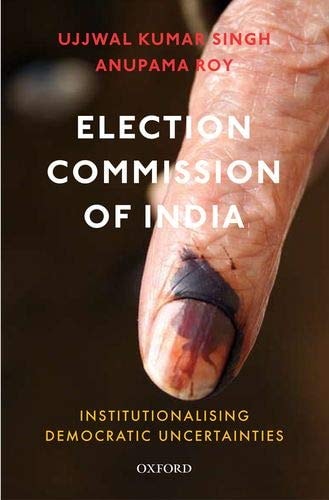
Responding to a pressing need for a focussed study of India's public institutions, Singh and Roy put together the first comprehensive monograph-length study of the Election Commission (EC) of India. They probe the consistent credibility that the EC enjoys as a non-partisan constitutional body entrusted with the responsibility of conducting elections in India. The EC is generally seen as a regulatory body which enforces rules to conduct elections effectively and efficiently. The authors argue that the EC must be seen as performing a range of functions, not all of which are regulatory. The EC is actively engaged in framing and implementing rules to ascertain procedural certainty in order to ensure the democratic principle of uncertainty of electoral outcome. Innovations in conducting elections which are often seen through the lens of electoral 'management' and 'electoral integrity' have become part of the deliberative content of elections. The work also examines the relationship between the legal-institutional frameworks of electoral governance within the larger institutional matrix of democracy, and the political field in which they are located. The latter, the authors argue, both limit and enable the effectiveness of the EC in the shared space of democracy in India.
Menrva's Summary
THE THESIS
This book investigates how the Election Commission of India functions as a constitutional body that balances procedural regulation with the inherent democratic necessity of electoral uncertainty. Authors Anupama Roy and Ujjwal Kumar Singh, both established scholars in political science, utilize a comprehensive institutional framework to analyze the EC's role. They argue that the commission is not merely a regulatory entity but a complex actor that shapes the political field while being simultaneously constrained by it. By examining the intersection of legal mandates and political reality, the authors provide a critical assessment of how electoral integrity is maintained within the Indian democratic matrix.
THE SCOPE MAP
What You Will Find
- A detailed analysis of the Election Commission of India as a constitutional institution.
- Examination of the relationship between electoral governance and the broader democratic political field.
- A study of how procedural innovations impact the concept of electoral uncertainty.
- An exploration of the tension between regulatory enforcement and democratic deliberative processes.
THE AUTHORITY PERSPECTIVE
Experts recognize this work as a foundational monograph that fills a significant gap in the study of Indian public institutions. Scholars frequently note the analytical depth of the authors' arguments regarding the institutional limitations and enabling factors of the Election Commission.
Page Count:
400
Publication Date:
2019-12-01
Publisher:
Oxford University Press
ISBN-10:
0199494258
ISBN-13:
9780199494255
Politics
History
World politics
Kindle eBooks
Systems Theory
Democracy
India
Elections
Elections & Political Process
Kindle Store
Government
Categories
Public Policy
Community Tags
Similar Books