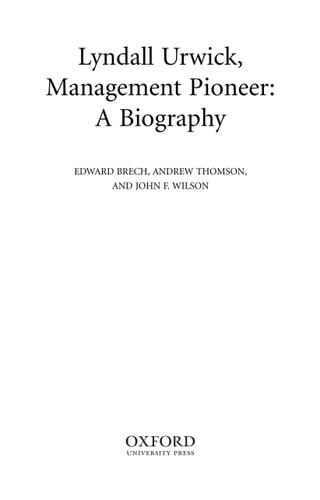
Lyndall Urwick, Management Pioneer: A Biography
0
0
As an Amazon Associate and affiliate partner, Menrva Books earns from qualifying purchases. Learn more
Author Description
Lyndall Urwick was the dominant figure in British management between the late 1920s and the early 1960s. His writings and his passion in pursuit of management as a scientific and systematic activity rather than the rule-of-thumb approach to decision-making all too prevalent in Britain exercised a huge influence on management at the time; and ultimately management as we know it today.Urwick was greatly affected by his experience of the First World War and at Rowntree's. He went on to become Director of the International Management Institute between 1928-33, before forming a very influential management consultancy, Urwick Orr and Partners, which he chaired for the rest of his career. He was also deeply involved with almost all the institutional developments in British management up to the 1960s, including the Management Research Groups, the Institute of Industrial Administration, the British Institute of Management, the Administrative Staff College, and the management education side of the Anglo-American Council on Productivity.In pursuit of what he called his 'mission at large', he gave hundreds of talks in his lucid and charismatic style, many of which were published as articles or booklets. These talks were not only in Britain but in Australia after his emigration there in 1961, in America, where he became the best-recognized foreign exponent of management, and in a range of countries around the world. But he will probably be best remembered for his writings, not only on organization theory, where he is recognized as a great synthesizer and leader in the classical school, but on a wide range of other topics, including the history of management, leadership, marketing, and management education and development. Truly he was a man of many parts.
Menrva's Summary
THE THESIS
This biography investigates the professional life and intellectual contributions of Lyndall Urwick, examining his role in transforming management from an intuitive practice into a systematic, scientific discipline. The authors, Andrew W. Thomson, Edward Brech, and John F. Wilson, utilize extensive archival research and historical documentation to trace Urwick's career from his formative experiences during the First World War to his global influence as a consultant and educator. They argue that Urwick’s 'mission at large' served as the primary catalyst for the institutionalization of management education and organizational theory in Britain and abroad throughout the mid-twentieth century.
THE SCOPE MAP
What You Will Find
- Detailed analysis of Urwick's tenure at the International Management Institute and the founding of Urwick Orr and Partners.
- Examination of his influence on the development of British management institutions, including the British Institute of Management and the Administrative Staff College.
- Primary source evidence derived from his numerous lectures, articles, and booklets on organization theory and leadership.
- A comprehensive overview of his global impact on management practices in Australia, America, and beyond.
THE AUTHORITY PERSPECTIVE
Experts recognize this work as a definitive account of a foundational figure in classical management theory. Readers frequently note the thoroughness of the historical research and the clarity with which the authors contextualize Urwick's contributions within the broader evolution of business administration.
Page Count:
256
Publication Date:
2010-09-03
Publisher:
Oxford University Press
ISBN-10:
0199541965
ISBN-13:
9780199541966
Business
History
Biography
Leadership
Great Britain
Management
Community Tags
Similar Books