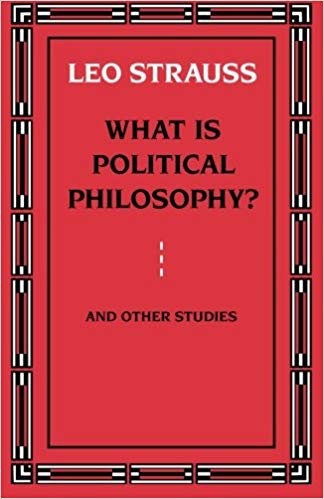
What Is Political Philosophy?
0
0
As an Amazon Associate and affiliate partner, Menrva Books earns from qualifying purchases. Learn more
Author Description
All political action has... in itself a directedness towards knowledge of the good: of the good life, or of the good society. For the good society is the complete political good. If this directedness becomes explicit, if men make it their explicit goal to acquire knowledge of the good life and of the good society, political philosophy emerges.... The theme of political philosophy is mankind's great objectives, freedom and government or empire—objectives which are capable of lifting all men beyond their poor selves. Political philosophy is that branch of philosophy which is closest to political life, to non-philosophic life, to human life.—From "What Is Political Philosophy?" What Is Political Philosophy?—a collection of ten essays and lectures and sixteen book reviews written between 1943 and 1957—contains some of Leo Strauss's most famous writings and some of his most explicit statements of the themes that made him famous. The title essay records Strauss's sole extended articulation of the meaning of political philosophy itself. Other essays discuss the relation of political philosophy to history, give an account of the political philosophy of the non-Christian Middle Ages and of classic European modernity, and present his theory of esoteric writing.
Menrva's Summary
THE THESIS
This collection explores the fundamental nature and historical development of political philosophy. Leo Strauss, a prominent political theorist, posits that political action inherently aims towards an understanding of the good life and the good society, which he identifies as the ultimate political good. When this pursuit of knowledge becomes explicit, political philosophy emerges, focusing on humanity's grand objectives of freedom and governance. The book delves into the relationship between political philosophy and history, examines the philosophies of the medieval and early modern periods, and introduces Strauss's theory of esoteric writing.
THE SCOPE MAP
- What is Political Philosophy?
- the title essay offering Strauss's explicit definition of the field.
- The relationship between political philosophy and history.
- An account of the political philosophy of the non-Christian Middle Ages.
- An examination of the political philosophy of classic European modernity.
- Presentation of Strauss's theory of esoteric writing.
- A collection of ten essays and lectures written between 1943 and 1957.
- Includes sixteen book reviews from the same period.
THE AUTHORITY PERSPECTIVE
This collection is regarded as a seminal work for understanding Leo Strauss's thought, particularly his definition of political philosophy and his views on its historical development. The essays are noted for their rigorous analysis and distinctive approach to understanding political thought across different eras. Readers and scholars often engage with Strauss's arguments on the nature of the good society and the role of knowledge in political action. The inclusion of his theory of esoteric writing also provides insight into his interpretive methods.
Page Count:
316
Publication Date:
1988-01-01
ISBN-10:
0226777138
ISBN-13:
9780226777139
Philosophy
Non-Fiction
Science
Political Philosophy
Community Tags
Similar Books