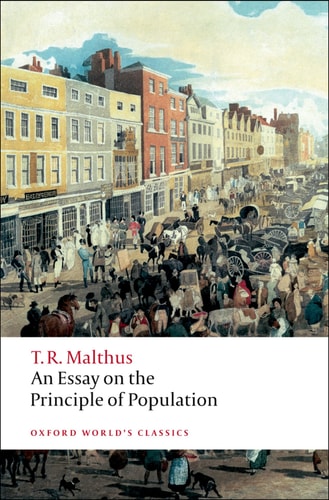
An Essay on the Principle of Population
0
0
As an Amazon Associate and affiliate partner, Menrva Books earns from qualifying purchases. Learn more
Author Description
As the world's population continues to grow at a frighteningly rapid rate, Malthus's classic warning against overpopulation gains increasing importance. An Essay on the Principle of Population (1798) examines the tendency of human numbers to outstrip their resources, and argues that checks in the form of poverty, disease, and starvation are necessary to keep societies from moving beyond their means of subsistence. Malthus's simple but powerful argument was controversial in his time; today his name has become a byword for active concern about humankind's demographic and ecological prospects.About the Series: For over 100 years Oxford World's Classics has made available the broadest spectrum of literature from around the globe. Each affordable volume reflects Oxford's commitment to scholarship, providing the most accurate text plus a wealth of other valuable features, including expert introductions by leading authorities, voluminous notes to clarify the text, up-to-date bibliographies for further study, and much more.
Menrva's Summary
THE THESIS
Does the geometric growth of human population inevitably outpace the arithmetic growth of food production, leading to systemic societal collapse? Thomas Malthus, an English cleric and scholar, utilizes demographic data and observations of 18th-century social conditions to argue that population growth is naturally constrained by misery and vice. He posits that without preventative checks, the human race will perpetually exist at the edge of subsistence due to the inherent limitations of agricultural output.
THE SCOPE MAP
What You Will Find
- Analysis of geometric versus arithmetic growth rates in human populations and food supplies.
- Examination of positive checks such as famine, disease, and war as mechanisms of population control.
- Discussion of moral restraint as a potential, though limited, method for curbing demographic expansion.
- Historical context regarding the Poor Laws and the socio-economic structure of late 18th-century Britain.
THE AUTHORITY PERSPECTIVE
Scholars recognize this text as a foundational document in the history of economic thought and demographic theory. Readers frequently note the dense, argumentative prose style that reflects the intellectual climate of the Enlightenment era.
Page Count:
172
Publication Date:
2008-08-01
Publisher:
Oxford University Press
ISBN-10:
0199540454
ISBN-13:
9780199540457
History
Philosophy
Economics
Sociology
Community Tags
Other Editions(15)

Blurb, Incorporated
2019
Default edition
Blurb, Incorporated
2019
CreateSpace Independent Publishing Platform
2017

CreateSpace Independent Publishing Platform
2017
CreateSpace Independent Publishing Platform
2016

CreateSpace Independent Publishing Platform
2016

CreateSpace Independent Publishing Platform
2016

CreateSpace Independent Publishing Platform
2016

CreateSpace Independent Publishing Platform
2013
Digireads.com Publishing
2013

CreateSpace Independent Publishing Platform
2010
Oxford University Press
2008

Echo Library
2006

Echo Library
2003
Oxford University Press
1994
Similar Books











Reader Comments
Share Your Thoughts
No comments yet. Be the first to share your thoughts!