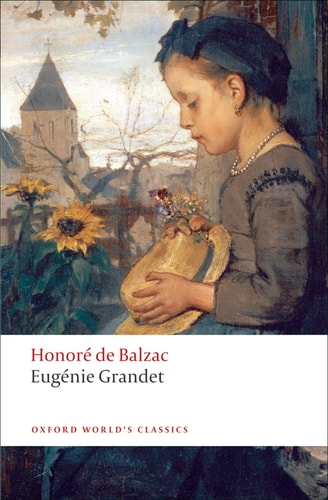
Eugénie Grandet
0
0
As an Amazon Associate and affiliate partner, Menrva Books earns from qualifying purchases. Learn more
Author Description
'Who is going to marry Eugénie Grandet?'This is the question that fills the minds of the inhabitants of Saumur, the setting for Eugénie Grandet (1833), one of the earliest and most famous novels in Balzac's Comédie humaine. The Grandet household, oppressed by the exacting miserliness of Grandet himself, is jerked violently out of routine by the sudden arrival of Eugénie's cousin Charles, recently orphaned and penniless. Eugénie's emotional awakening, stimulated by her love for her cousin, brings her into direct conflict with her father, whose cunning and financial success are matched against her determination to rebel.Eugénie's moving story is set against the backdrop of provincial oppression, the vicissitudes of the wine trade, and the workings of the financial system in the aftermath of the French Revolution. It is both a poignant portrayal of private life and a vigorous fictional document of its age.About the Series: For over 100 years Oxford World's Classics has made available the broadest spectrum of literature from around the globe. Each affordable volume reflects Oxford's commitment to scholarship, providing the most accurate text plus a wealth of other valuable features, including expert introductions by leading authorities, voluminous notes to clarify the text, up-to-date bibliographies for further study, and much more.
Menrva's Summary
THE PULSE
The arrival of a penniless cousin disrupts the suffocating, miserly existence of the Grandet household, forcing a young woman to choose between filial obedience and her own emotional awakening. Eugénie Grandet lives under the iron-fisted control of her father, a wealthy but pathologically stingy man whose life revolves entirely around the accumulation of capital. When her cousin Charles arrives from Paris, Eugénie experiences a profound shift in perspective, leading to a direct confrontation with her father's rigid financial and moral authority. The narrative, presented with the clinical precision of Balzac's realist style, examines the intersection of private desire and the cold, calculating nature of provincial society in post-Revolutionary France.
INSIDE THE PAGES
- Detailed examination of provincial social hierarchies and class dynamics
- Exploration of the psychological toll of extreme avarice
- Use of the domestic sphere as a microcosm for national economic shifts
- Third-person omniscient narrative voice providing social commentary
- Focus on the impact of the French Revolution on property and inheritance
- Character-driven conflict centered on the tension between duty and autonomy
- Vivid descriptions of the wine trade and financial speculation
- Gradual pacing that mirrors the slow, oppressive atmosphere of the Grandet home
THE COLLECTIVE ECHO
Readers and critics frequently highlight Balzac's ability to render the mundane details of provincial life with intense, almost obsessive clarity. Discussion often centers on the stark contrast between Eugénie's internal emotional growth and the external, rigid constraints imposed by her father's greed. Many observers note that the novel serves as a foundational text for the realist movement, effectively capturing the social and economic anxieties of the nineteenth century. The pacing is often described as deliberate, allowing the reader to fully inhabit the claustrophobic environment of the Grandet household. Ultimately, the work is recognized for its unflinching look at how financial systems can distort human relationships and personal identity.
Page Count:
200
Publication Date:
2009-08-31
Publisher:
Oxford University Press
ISBN-10:
0199555893
ISBN-13:
9780199555895
Social Commentary
classic
Realism
Historical
France fiction
French literature
Community Tags
Other Editions(7)





Similar Books










Reader Comments
Share Your Thoughts
No comments yet. Be the first to share your thoughts!