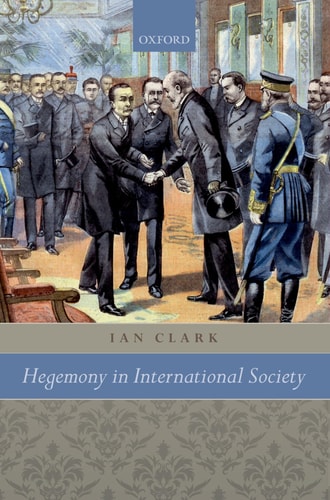
Hegemony in International Society
0
0
As an Amazon Associate and affiliate partner, Menrva Books earns from qualifying purchases. Learn more
Author Description
Can international legitimacy operate even in a deformed balance of power, and when there is only one dominant state? Conventionally, hegemony has been perceived as a threat to international society. But how then is international order to be maintained, if this still requires a managerial role on the part of the great powers? International Relations theory has not taken that problem sufficiently seriously. Hegemony in International Society study makes a sharp distinction between primacy, denoting merely a form of material power, and hegemony, understood as a legitimate practice, and as giving rise to a form of social power. Clark suggests hegemony be considered as one potential institution of international society, and hence as one possible mechanism of international order.Hegemony in International Society reviews some relevant historical cases (the Concert of Europe, Pax Britannica, and Pax Americana) and argues that, instead of one model of hegemony, these represent several different variants: importantly, each displays its own distinctive legitimacy dynamics. Once these are appreciated, they can help us identify the possible institutional forms of hegemony in contemporary international society. This is done through three cases, examining in turn US policy on the UN Security Council, in East Asia, and on climate change. The overall argument challenges the limited post-Cold War debate about primacy, and the equally simplistic projections about the future distribution of power to which it gives rise. In doing so, it offers a major re-thinking of the concept of hegemony in international relations.
Menrva's Summary
THE THESIS
This book investigates whether hegemony can function as a legitimate institution of international order rather than merely a threat to the balance of power. Ian Clark, a prominent scholar in International Relations theory, challenges the conventional academic focus on material primacy by proposing that hegemony should be understood as a social practice. By analyzing the distinction between raw power and legitimate authority, the author provides a framework for evaluating how dominant states manage international society in the contemporary era.
THE SCOPE MAP
What You Will Find
- Historical analysis of the Concert of Europe, Pax Britannica, and Pax Americana.
- A theoretical distinction between material primacy and legitimate social power.
- Case studies on US policy regarding the UN Security Council, East Asian relations, and global climate change.
- A critical evaluation of post-Cold War debates concerning the distribution of global power.
THE AUTHORITY PERSPECTIVE
Experts in the field of International Relations recognize this work as a significant contribution to the study of global order and institutional legitimacy. Readers frequently note the academic density of the prose, which serves as a foundational text for those examining the intersection of power dynamics and international law.
Page Count:
296
Publication Date:
2011-06-20
Publisher:
Oxford University Press
ISBN-10:
0199556261
ISBN-13:
9780199556267
History
International relations
Geopolitics
Hegemony
Diplomacy
Community Tags
Other Editions(2)
Similar Books