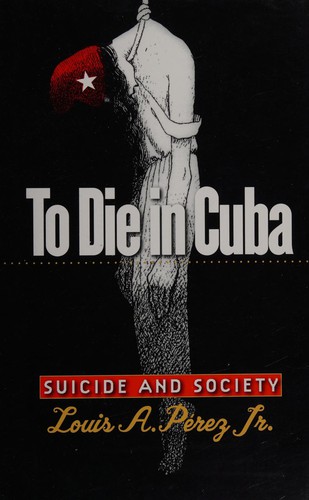
To Die in Cuba
0
0
As an Amazon Associate and affiliate partner, Menrva Books earns from qualifying purchases. Learn more
Author Description
In this illustrated social and cultural history of suicide in Cuba, Louis A. Perez, Jr. explores the way suicide passed from the unthinkable to the unremarkable in Cuban society. In a study that spans the experiences of enslaved Africans and indentured Chinese in the colony, nationalists of the twentieth-century republic, and emigrants from Cuba to Florida following the 1959 revolution, Perez finds that the act of suicide was loaded with meanings that changed over time. Under certain circumstances, it served to consecrate the proposition of nation; at other times, it confirmed despair and hopelessness. It could be a function of heroism or a result of humiliation. In perhaps the most noteworthy and most celebrated form of voluntary death in Cuba, suicide was construed as a political act, a sacrifice of one's life on behalf of some ideal associated with the exaltation of the nation. By the twentieth century, suicide had become a common subject in literature, music, and the popular media, where it was often treated as a source of humor. Bringing an important historical perspective to the study of suicide, Perez offers a valuable new understanding of the strategies with which vast numbers of people made their way through life - if only to choose to end it. To Die in Cuba ultimately tells as much about Cubans' lives, culture, and society as it does about their self-inflicted deaths.--Jacket.
Menrva's Summary
THE THESIS
This book investigates the evolving meanings and societal acceptance of suicide in Cuba across different historical periods and social groups. Louis A. Perez, Jr., a historian with extensive research on Cuban society, examines suicide from the era of enslaved Africans and indentured Chinese to 20th-century nationalists and post-1959 emigrants. The study analyzes how the act of suicide was imbued with varied meanings, serving variously as a consecration of nationhood, an expression of despair, an act of heroism, or a consequence of humiliation. Ultimately, the book argues that suicide in Cuba became a significant cultural and political phenomenon, deeply intertwined with the nation's identity and lived experiences.
THE SCOPE MAP
- Exploration of suicide among enslaved Africans and indentured Chinese in colonial Cuba.
- Analysis of suicide as a political act and sacrifice for national ideals in the 20th century.
- Examination of the experiences of emigrants from Cuba to Florida following the 1959 revolution.
- Discussion of how suicide transitioned from unthinkable to unremarkable in Cuban society.
- Investigation of suicide's representation in Cuban literature, music, and popular media, including its treatment as humor.
- Focus on suicide as a strategy for navigating life and a choice to end it.
- The book's ultimate aim to illuminate Cuban lives, culture, and society through the lens of self-inflicted deaths.
THE AUTHORITY PERSPECTIVE
This book offers a significant historical perspective on suicide in Cuba, providing a nuanced understanding of how the act's meaning and societal perception shifted over time. The research spans diverse populations and historical epochs, revealing suicide's complex role in Cuban identity, from political sacrifice to expressions of despair. The study's comprehensive scope and analytical depth are likely to be valued by scholars of Cuban history, sociology, and cultural studies. By examining the strategies people employed to navigate life, even through its end, the book ultimately sheds light on the broader human experience within a specific cultural context.
Page Count:
463
Publication Date:
2005-01-01
ISBN-10:
0807829374
Non-Fiction
History
Sociology
Social History
Cuba
Cultural History
Community Tags
Similar Books