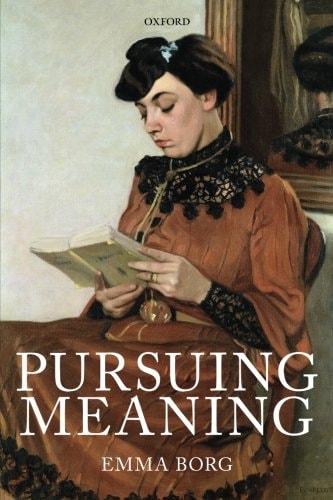
Pursuing Meaning
0
0
As an Amazon Associate and affiliate partner, Menrva Books earns from qualifying purchases. Learn more
Author Description
Emma Borg examines the relation between semantics (roughly, features of the literal meaning of linguistic items) and pragmatics (features emerging from the context within which such items are being used), and assesses recent answers to the fundamental questions of how and where to draw the divide between the two. In particular, she offers a defence of what is commonly known as "minimal semantics." Minimal semantics, as the name suggests, wants to offer a minimal account of the interrelation between semantics and pragmatics. Specifically, it holds that while context can affect literal semantic content in the case of genuine (i.e. lexically or syntactically marked) context-sensitive expressions, this is the limit of pragmatic input to semantic content. On all other occasions where context of utterance appears to affect content, the minimalist claims that what it affects is not literal, semantic content but what the speaker conveys by the use of this literal content--it affects what a speaker says but not what a sentence means. As Borg makes clear, the minimalist must allow some contextual influence on semantic content, but her claim is that this influence can be limited to "tame" pragmatics--the kind of rule-governed appeals to context which won't scare formally minded horses. Pursuing Meaning aims to make good on this claim. The book also contains an overview of all the main positions in the area, clarification of its often complex terminology, and an exploration of key themes such as word meaning, mindreading, and the relationship between semantics and psychology.
Menrva's Summary
THE THESIS
This book investigates the fundamental boundary between semantics and pragmatics, specifically evaluating the viability of a minimalist account of linguistic meaning. Emma Borg, a philosopher of language, utilizes formal logic and linguistic theory to argue that pragmatic influence on semantic content should be restricted to lexically or syntactically marked expressions. By distinguishing between literal sentence meaning and speaker-conveyed content, she provides a framework for understanding how context interacts with language without compromising the stability of semantic truth conditions.
THE SCOPE MAP
What You Will Find
- An analysis of the divide between literal semantic content and contextual pragmatic input.
- A defense of minimal semantics as a robust theoretical framework.
- An overview of competing positions in contemporary philosophy of language.
- Explorations of word meaning, mindreading, and the intersection of semantics and psychology.
THE AUTHORITY PERSPECTIVE
Experts recognize this work as a significant contribution to the debate surrounding semantic minimalism and contextualism. Scholars frequently note the technical rigor of the prose, making it a foundational text for advanced students and researchers in the philosophy of language.
Page Count:
224
Publication Date:
2012-07-26
Publisher:
Oxford University Press
ISBN-10:
0199588376
ISBN-13:
9780199588374
Philosophy
Pragmatics
Linguistics
Semantics