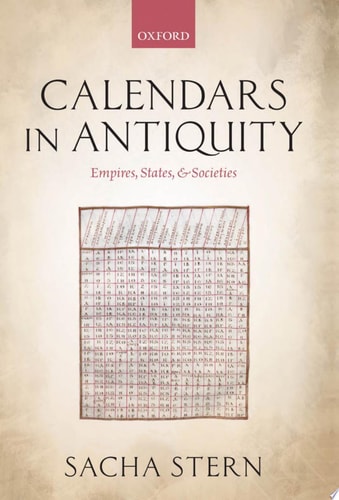
Calendars in Antiquity: Empires, States, and Societies
0
0
As an Amazon Associate and affiliate partner, Menrva Books earns from qualifying purchases. Learn more
Author Description
Calendars were at the heart of ancient culture and society, and were far more than just technical, time-keeping devices. Calendars in Antiquity offers a comprehensive study of the calendars of ancient Mesopotamia, Egypt, Persia, Greece, Rome, Gaul, and all other parts of the Mediterranean and the Near East, from the origins up to and including Jewish and Christian calendars in late Antiquity. In this volume, Stern sheds light on the political context in which ancient calendars were designed and managed. Set and controlled by political rulers, calendars served as expressions of political power, as mechanisms of social control, and sometimes as assertions of political independence, or even of sub-culture and dissidence.While ancient calendars varied widely, they all shared a common history, evolving on the whole from flexible, lunar calendars to fixed, solar schemes. The Egyptian calendar played an important role in this process, leading most notably to the institution of the Julian calendar in Rome, the forerunner of our modern Gregorian calendar. Stern argues that this common, evolutionary trajectory was not the result of scientific or technical progress. It was rather the result of major political and social changes that transformed the ancient world, with the formation of the great Near Eastern empires and then the Hellenistic and Roman Empires from the first millennium BC to late Antiquity. The institution of standard, fixed calendars served the administrative needs of these great empires but also contributed to their cultural cohesion.
Menrva's Summary
THE THESIS
This work investigates how ancient calendars functioned as instruments of political authority and social organization rather than merely as technical time-keeping tools. Sacha Stern, a scholar of Jewish history and ancient chronology, utilizes a vast array of historical and archaeological evidence to argue that the transition from lunar to solar calendars was driven by imperial administrative needs and political shifts rather than scientific advancement. He posits that the standardization of time served as a mechanism for cultural cohesion and control across the Near East and Mediterranean worlds.
THE SCOPE MAP
What You Will Find
- Comparative analysis of calendar systems in Mesopotamia, Egypt, Persia, Greece, Rome, and Gaul.
- Examination of the transition from flexible lunar cycles to fixed solar schemes.
- Discussion of the role of the Julian calendar as a precursor to modern systems.
- Analysis of how calendars functioned as tools for political power, social control, and cultural identity.
THE AUTHORITY PERSPECTIVE
Scholars recognize this text as a comprehensive reference for the intersection of chronology and political history in the ancient world. Readers frequently note the academic density of the prose, which provides a rigorous framework for understanding the evolution of time-keeping systems.
Page Count:
472
Publication Date:
2012-11-15
Publisher:
Oxford University Press
ISBN-10:
0199589445
ISBN-13:
9780199589449
History
Sociology
Chronology
Ancient History
Calendar
Community Tags
Similar Books