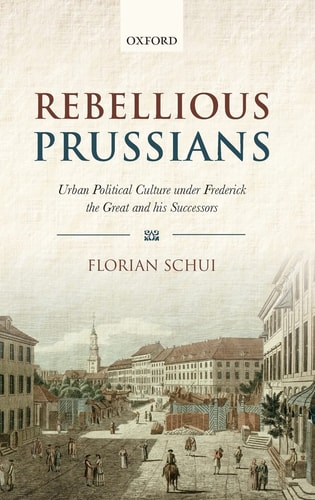
Rebellious Prussians: Urban Political Culture under Frederick the Great and his Successors
0
0
As an Amazon Associate and affiliate partner, Menrva Books earns from qualifying purchases. Learn more
Author Description
Prussian discipline is legendary. Central to debates about modern German history is the view that an oppressive Prussian state cast a shadow on the development of civil society. In particular, historians have seen the absence of a revolution in the eighteenth century as a symptom of a delayed and incomplete emancipation of the Prussian bourgeoisie. Prussia's urban dwellers have often been portrayed as poor relations of the self-reliant and assertive bourgeois of Western Europe and the Atlantic world. Economically backward and politically oppressed, they were allegedly in no position to challenge the iron grip of the state and question the authority of the Hohenzollern dynasty.Drawing from extensive and original research, Florian Schui challenges the accepted view and argues that Prussians in the eighteenth century were much more willing to challenge the state than has been recognised. Schui explores several instances where urban Prussians successfully resisted government policies and forced Frederick the Great and his successors to give in to their demands. Rebellious Prussians thus sheds light on a little-known historical reality in which weak Hohenzollern monarchs--and a still weaker Prussian bureaucracy--were confronted with prosperous, fearless, argumentative, and occasionally violent Prussian burghers.Such conflicts between state and citizens were by no means unique to Prussia. Rather the events in Prussia were, on many levels, connected to similar contemporary developments in other parts of Europe and North America. Florian Schui systematically explores these links and thus develops a new European and Atlantic perspective on Prussian history in the eighteenth century.
Menrva's Summary
THE THESIS
Did the Prussian urban population in the eighteenth century lack the political agency and revolutionary spirit found in their Western European counterparts? Florian Schui, a historian specializing in the political and economic history of the Enlightenment, challenges the traditional historiography that characterizes Prussian burghers as passive subjects of an absolute monarchy. By examining archival records of urban resistance, Schui argues that the Prussian state was frequently forced to negotiate with a politically active and assertive citizenry, thereby reframing the narrative of Prussian political development within a broader Atlantic context.
THE SCOPE MAP
What You Will Find
- Analysis of urban resistance movements against Hohenzollern administrative policies.
- Comparative study linking Prussian political culture to contemporary developments in Europe and North America.
- Examination of the limitations of the Prussian bureaucracy and the relative weakness of the monarchy in local governance.
- Evidence derived from original archival research regarding public protests, petitions, and civic disputes.
THE AUTHORITY PERSPECTIVE
Scholars recognize this work as a significant revisionist contribution to the study of the Enlightenment and Prussian state formation. Readers frequently note the clarity with which Schui connects local urban conflicts to the wider political currents of the eighteenth-century Atlantic world.
Page Count:
240
Publication Date:
2013-05-10
Publisher:
Oxford University Press
ISBN-10:
0199593965
ISBN-13:
9780199593965
History
Social History
Germany history
18th century
European History
Political History
German history
Community Tags
Other Editions(2)

Similar Books