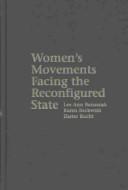
Women's Movements Facing the Reconfigured State
0
0
As an Amazon Associate and affiliate partner, Menrva Books earns from qualifying purchases. Learn more
Author Description
This book examines the relationship between women's movements and states in West Europe and North America, as states have relocated their formal powers and policy-making responsibilities. Since the 1980s, North American and West European states have reduced the scope and volume of their national responsibilities, increasingly employing neoliberal free market rhetoric, and developed transnational economic and political authorities. Simultaneously, second wave women's movements have been transformed. Movements that were revolutionary in rhetoric, autonomous from states, and largely informally organized in the 1970s are, by the 1990s, employing moderate neoliberal rhetoric, entering state institutions as active participants, and creating more formal organizations. Utilizing a common theoretical framework, the contributors examine how movements have influenced the reconfiguration of nation-states and how these changes have influenced the goals, mobilization, tactics, success and rhetoric of women's movements in various Western European and North American countries.
Menrva's Summary
THE THESIS
This book investigates how women's movements have adapted to and influenced the significant transformations of state structures in Western Europe and North America since the 1980s. The analysis focuses on the shift from revolutionary, autonomous movements of the 1970s to more moderate, institutionally integrated organizations by the 1990s, coinciding with states' adoption of neoliberal rhetoric and the development of transnational authorities. The contributors employ a shared theoretical framework to explore the reciprocal relationship between movement evolution and state reconfiguration, examining impacts on movement goals, mobilization, tactics, and overall success.
THE SCOPE MAP
- Analysis of the relationship between women's movements and states in Western Europe and North America.
- Examination of state reconfigurations, including the relocation of formal powers and policy-making responsibilities.
- Discussion of the impact of neoliberal free market rhetoric on state functions and movement strategies.
- Exploration of the transformation of second-wave women's movements from autonomous, informal organizations to more formal, institutionally engaged bodies.
- Comparative study of movement goals, mobilization, tactics, and rhetoric across various Western European and North American countries.
- Application of a common theoretical framework to understand movement influence on state changes and vice versa.
THE AUTHORITY PERSPECTIVE
This comparative study offers a detailed examination of the evolving dynamics between feminist activism and state power in Western democracies. The contributors' use of a unified theoretical framework allows for a consistent analysis of how social movements respond to and shape political landscapes, particularly in the context of shifting state responsibilities and the rise of neoliberalism. The book is likely to be of interest to scholars of social movements, gender studies, and comparative politics, providing insights into the strategic adaptations of activism in response to state transformations.
Page Count:
372
Publication Date:
2003-01-01
ISBN-10:
052181278X
ISBN-13:
9780521812788
Politics
Non-Fiction
History
Comparative Politics
Sociology
Community Tags
Similar Books