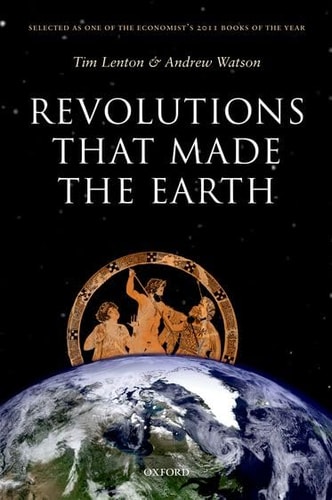
Revolutions that Made the Earth
0
0
As an Amazon Associate and affiliate partner, Menrva Books earns from qualifying purchases. Learn more
Author Description
The Earth that sustains us today was born out of a few remarkable, near-catastrophic revolutions, started by biological innovations and marked by global environmental consequences. The revolutions have certain features in common, such as an increase in the complexity, energy utilization, and information processing capabilities of life. This book describes these revolutions, showing the fundamental interdependence of the evolution of life and its non-living environment. We would not exist unless these upheavals had led eventually to 'successful' outcomes - meaning that after each one, at length, a new stable world emerged.The current planet-reshaping activities of our species may be the start of another great Earth system revolution, but there is no guarantee that this one will be successful. This book explains what a successful transition through it might look like, if we are wise enough to steer such a course.This book places humanity in context as part of the Earth system, using a new scientific synthesis to illustrate our debt to the deep past and our potential for the future.
Menrva's Summary
THE THESIS
This book investigates the series of near-catastrophic biological and environmental revolutions that shaped the Earth into its current life-sustaining state. Authors Andrew J. Watson and Tim Lenton, both distinguished scientists in the fields of Earth system science and biology, synthesize geological history and evolutionary theory to argue that life and the non-living environment are fundamentally interdependent. They propose that these past upheavals share common markers, including increased energy utilization and information processing, and suggest that humanity's current impact on the planet may represent the onset of a new, potentially precarious Earth system revolution.
THE SCOPE MAP
What You Will Find
- Analysis of major historical biological innovations and their global environmental consequences.
- A framework for understanding the co-evolution of life and the Earth system.
- Examination of the criteria for a successful transition between planetary states.
- Discussion of humanity's role and potential future within the context of deep-time Earth history.
THE AUTHORITY PERSPECTIVE
Experts and readers alike recognize this work as a significant synthesis of complex Earth system science, noting its ability to bridge the gap between biological evolution and geological change. The prose is considered accessible to those with an interest in science, though it maintains a rigorous academic foundation regarding the mechanics of planetary transitions.
Page Count:
423
Publication Date:
2013-05-19
Publisher:
Oxford University Press
ISBN-10:
0199673462
ISBN-13:
9780199673469
Science
Non-Fiction
Evolutionary Biology
Geology
Earth Science
Gaia hypothesis
Community Tags
Similar Books