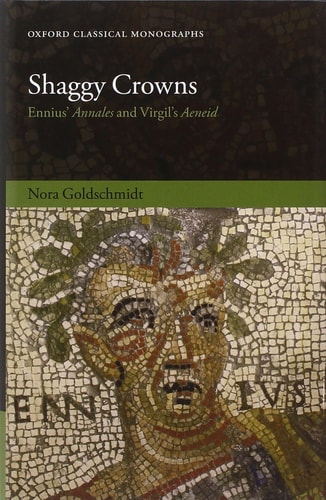
Shaggy Crowns: Ennius' Annales and Virgil's Aeneid
0
0
As an Amazon Associate and affiliate partner, Menrva Books earns from qualifying purchases. Learn more
Author Description
Shaggy Crowns is the first book-length study in almost a hundred years of the relationship between Rome's two great epic poems. Quintus Ennius was once the monumental epic poet of Republican Rome, "the father of Roman poetry." However, around one hundred and fifty years after his epic Annales first appeared, it was replaced decisively by Virgil's Aeneid, and now survives only in fragments.Looking at the intersections between intertextuality and the appropriations of cultural memory, Goldschmidt considers the relationship between Rome's two great canonical epics. She focuses on how -- in the use of archaism, the presentation of landscape, embedded memories of the Punic Wars, and fragments of exempla -- Virgil's poem appropriates and re-writes the myths and memories which Ennius had enshrined in Roman epic. Goldschmidt argues that Virgil was not just a slicker "new poet," but constructed himself as an older "archaic poet" of the deepest memories of the Roman past, ultimately competing for the "shaggy crown" of Ennius.
Menrva's Summary
THE THESIS
This study investigates the complex intertextual relationship between Quintus Ennius's Annales and Virgil's Aeneid to determine how the latter supplanted the former in the Roman literary canon. Nora Goldschmidt, a scholar of Latin literature, examines the mechanisms of cultural memory and literary appropriation within these two foundational epics. By analyzing how Virgil utilized archaism and historical memory to reframe the Roman past, the author argues that Virgil actively engaged with Ennius to position himself as the true heir to the archaic tradition.
THE SCOPE MAP
What You Will Find
- Analysis of intertextual dynamics between Republican and Augustan epic poetry.
- Examination of the use of archaism and landscape in Roman literature.
- Investigation into the cultural memory of the Punic Wars as depicted in epic fragments.
- Theoretical framework regarding the appropriation of literary exempla.
THE AUTHORITY PERSPECTIVE
Reader & Expert Consensus: Scholars recognize this work as a significant contribution to the study of Roman epic, particularly for its focus on the often-overlooked influence of Ennius. Readers frequently note the academic density of the prose, which is intended for specialists in classical philology and Roman history.
Page Count:
272
Publication Date:
2014-02-28
Publisher:
Oxford University Press
ISBN-10:
0199681295
ISBN-13:
9780199681297
Poetry
History
Literary Criticism
Criticism history
Virgil
Intertextuality
Community Tags
Other Editions(2)
Similar Books