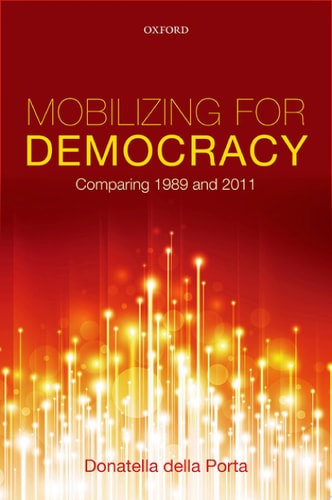
Mobilizing for Democracy: Comparing 1989 and 2011
0
0
As an Amazon Associate and affiliate partner, Menrva Books earns from qualifying purchases. Learn more
Author Description
Strangely enough, while the pictures used to illustrate the most recent wave of protests for democracy in North Africa represent mass protest, research on social movements and democratization have rarely interacted. This volume aims to fill this gap by looking at episodes of democratization through the lens of social movement studies. Without assuming that democratization is always produced from below, the author singles out different paths of democratization by looking at the ways in which the masses interact with the elites, and protest with bargaining: eventful democratization, participated pacts and troubled democratization. The main focus is on the first of the paths: eventful democratization, that is cases in which authoritarian regimes break down following-often short but intense-waves of protest. Recognizing the particular power of some transformative events, the analysis locates them within the broader mobilization processes, including the multitude of less visible, but still important protests that surround them. Cognitive, affective and relational mechanisms are singled out as transforming the contexts in which dissidents act. In all three paths, mobilization of resources, framing processes and appropriation of opportunities will develop in action, in different combinations. The comparison of different cases within two waves of protests for democracy, in Central Eastern Europe in 1989 and in the Middle East and North Africa in 2011, allows the author to theorize about causal mechanisms and conditions as they emerge in mobilizations for democracy.
Menrva's Summary
THE THESIS
This volume investigates the relationship between social movement dynamics and the processes of democratization by comparing the 1989 Central Eastern European uprisings with the 2011 Arab Spring. Prof. Donatella della Porta, a prominent scholar in social movement studies, utilizes a comparative framework to analyze how mass mobilization interacts with elite bargaining during regime transitions. By examining cognitive, affective, and relational mechanisms, the author argues that democratization is not a singular phenomenon but a result of varying combinations of resource mobilization and framing processes.
THE SCOPE MAP
What You Will Find
- Comparative analysis of the 1989 Central Eastern European protests and the 2011 Middle East and North Africa uprisings.
- Theoretical framework for 'eventful democratization' versus 'participated pacts' and 'troubled democratization'.
- Examination of how mass protest interacts with elite political bargaining.
- Identification of cognitive, affective, and relational mechanisms that influence dissident action.
THE AUTHORITY PERSPECTIVE
Scholars in the field of political sociology recognize this work as a significant bridge between social movement theory and democratization studies. Readers frequently note the academic density of the prose, which provides a rigorous, systematic approach to understanding complex political transitions.
Page Count:
384
Publication Date:
2014-05-06
Publisher:
Oxford University Press
ISBN-10:
0199689326
ISBN-13:
9780199689323
History
International relations
Africa North
Sociology
Comparative Politics
Middle East
Community Tags
Similar Books