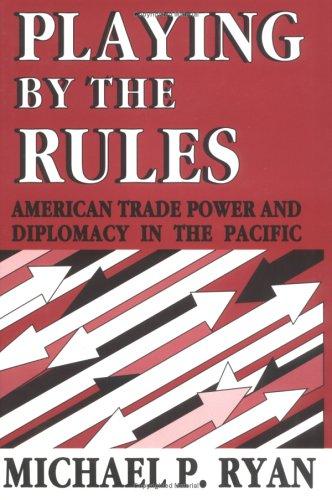
Playing by the Rules
0
0
As an Amazon Associate and affiliate partner, Menrva Books earns from qualifying purchases. Learn more
Author Description
Ryan evaluates the nature and effectiveness of U.S. trade diplomacy with Japan, Korea, Taiwan, and China in the 1970s and 1980s by examining the diplomatic strategies used by the U.S. Trade Representative to enforce Section 301 of the 1974 Trade Act, which was designed to protect free trade and competition through investigations, negotiations, and sanctions. Ryan shows the different trade diplomacy tactics the East Asian governments pursued during dispute settlement negotiations with the USTR. The study also evaluates the fit between the East Asian political economies and the rules and principles of the General Agreement on Trade and Tariffs (GATT) regime. In the debate over rule-based or power-based diplomacy, Ryan concludes that U.S. trade diplomacy was most successful when it was rule-based, and that it gained significant compliance with GATT and other fair trade agreements. Ryan interviewed many of the key trade negotiators in Tokyo, Seoul, Taipei, Beijing, and Washington. His analysis is based on the largest, most systematic, market sector-specific data set yet presented on U.S. export trade dispute settlement in the Pacific. It studies the structure of state power; the structures of international business competition in manufacturing, agriculture, and services; the international and regional institutions of trade diplomacy; and the national governmental institutions of trade diplomacy in the Pacific.
Menrva's Summary
THE THESIS
This book investigates the effectiveness of U.S. trade diplomacy with East Asian nations in the 1970s and 1980s, focusing on the enforcement of trade agreements. Michael P. Ryan examines the strategies employed by the U.S. Trade Representative under Section 301 of the 1974 Trade Act, which aimed to promote free trade through investigations, negotiations, and sanctions. The study analyzes the distinct trade diplomacy tactics used by Japan, Korea, Taiwan, and China, and assesses how their political economies aligned with the rules of the General Agreement on Trade and Tariffs (GATT). Ryan concludes that rule-based diplomacy was more successful in achieving compliance with fair trade agreements.
THE SCOPE MAP
- Analysis of U.S. trade diplomacy strategies in Japan, Korea, Taiwan, and China during the 1970s and 1980s.
- Examination of the enforcement of Section 301 of the 1974 Trade Act.
- Evaluation of the diplomatic strategies used by the U.S. Trade Representative.
- Study of the trade diplomacy tactics employed by East Asian governments.
- Assessment of the compatibility of East Asian political economies with GATT rules and principles.
- Conclusion on the effectiveness of rule-based versus power-based diplomacy.
- Interviews with key trade negotiators from Tokyo, Seoul, Taipei, Beijing, and Washington.
- Analysis based on a large, systematic, market sector-specific data set of U.S. export trade dispute settlement in the Pacific.
THE AUTHORITY PERSPECTIVE
The book is an analytical study of U.S. trade diplomacy, drawing on extensive interviews and data to evaluate the effectiveness of rule-based approaches. It examines the interplay between national economic policies and international trade regimes like GATT. The research provides insights into the structures of state power and international business competition within the Pacific region during a critical period of economic development. The work is positioned as a significant contribution to understanding the mechanics of international trade negotiations.
Page Count:
228
Publication Date:
1995-01-01
ISBN-10:
0878405798
ISBN-13:
9780878405794
Politics
Non-Fiction
History
Economic History
International relations
Trade Policy
Community Tags
Similar Books