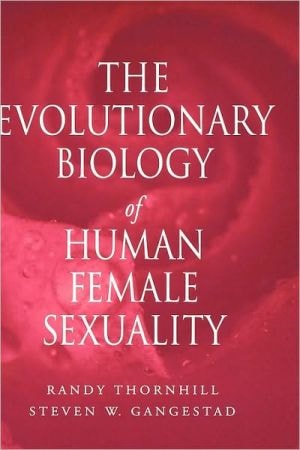
The Evolutionary Biology of Human Female Sexuality
0
0
As an Amazon Associate and affiliate partner, Menrva Books earns from qualifying purchases. Learn more
Author Description
Research conducted in the last fifteen years has placed in question many of the traditional conclusions scholars have formed about human female sexuality. Though conventional wisdom asserts that women's estrus has been evolutionarily lost, Randy Thornhill and Steven W. Gangestad assert that it is present, though concealed. Women, they propose, therefore exhibit two sexualities each ovulatory cycle-estrus and sexuality outside of the estrous phase, extended sexuality-that possess distinct functions. Synthesizing research in behavioral evolution and comparative biology, the authors provide a new theoretical framework for understanding the evolution of human female sexuality, one that is rooted in female sexuality and phylogeny across all vertebrate animals.
Menrva's Summary
THE THESIS
This book investigates whether human female estrus has been evolutionarily lost or if it remains present but concealed throughout the ovulatory cycle. Randy Thornhill and Steven W. Gangestad, both established researchers in behavioral evolution, challenge conventional academic wisdom by proposing that women possess two distinct sexualities—estrus and extended sexuality—each serving different evolutionary functions. By synthesizing comparative biology and behavioral data, the authors construct a theoretical framework that situates human female sexuality within the broader context of vertebrate phylogeny.
THE SCOPE MAP
What You Will Find
- A comparative analysis of vertebrate reproductive strategies and phylogeny.
- A dual-process framework distinguishing between estrous and non-estrous sexual phases.
- Synthesis of behavioral evolution research conducted over a fifteen-year period.
- Theoretical arguments regarding the concealment of ovulation in human females.
THE AUTHORITY PERSPECTIVE
Experts in evolutionary psychology and biology recognize this work as a significant contribution to the debate surrounding human reproductive strategies. Readers frequently note the academic density of the prose and the rigorous, data-driven approach the authors employ to support their controversial hypothesis.
Page Count:
0
Publication Date:
1900-01-01
Publisher:
Oxford University Press
ISBN-10:
0199712492
ISBN-13:
9780199712496
Science
Psychology
Biology
Anthropology
Evolutionary Biology
Community Tags
Similar Books