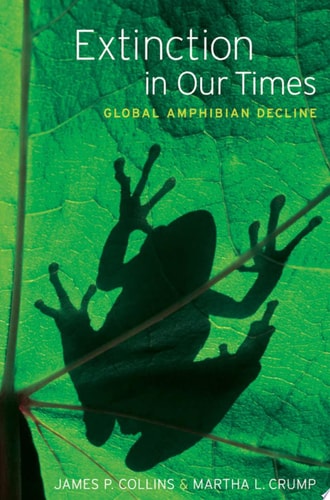
Extinction in Our Times
0
0
As an Amazon Associate and affiliate partner, Menrva Books earns from qualifying purchases. Learn more
Author Description
For Over 350 Million Years, Thousands Of Species Of Amphibians Have Lived On Earth, But Since The 1990s They Have Been Disappearing At An Alarming Rate, In Many Cases Quite Suddenly And Mysteriously. What Is Causing These Extinctions? What Role Do Human Actions Play In Them? What Do They Tell Us About The Overall State Of Biodiversity On The Planet? In Extinction In Our Times, James Collins And Martha Crump Explore These Pressing Questions And Many Others As They Document The First Modern Extinction Event Across An Entire Vertebrate Class, Using Global Examples That Range From The Sierra Nevada Of California To The Rainforests Of Costa Rica And The Mediterranean Coast Of North Africa. Joining Scientific Rigor And Vivid Storytelling, This Book Is The First To Use Amphibian Decline As A Lens Through Which To See More Clearly The Larger Story Of Climate Change, Conservation Of Biodiversity, And A Host Of Profoundly Important Ecological, Evolutionary, Ethical, Philosophical, And Sociological Issues.
Menrva's Summary
THE THESIS
This book investigates the rapid, mysterious decline of amphibian populations worldwide and the broader implications this event holds for global biodiversity and ecological stability. James P. Collins, a biologist with extensive experience in amphibian ecology, and Martha L. Crump, a renowned herpetologist, synthesize decades of field research and global data to address this crisis. They argue that the disappearance of amphibians serves as a critical indicator of environmental degradation, linking local population collapses to systemic issues like climate change and habitat loss. The authors provide a comprehensive framework for understanding how human activity accelerates extinction events across an entire vertebrate class.
THE SCOPE MAP
What You Will Find
- Global case studies of amphibian decline spanning the Sierra Nevada, Costa Rica, and North Africa
- Analysis of the intersection between climate change and biodiversity loss
- Examination of the ecological, evolutionary, and ethical dimensions of mass extinction
- Synthesis of scientific data regarding the sudden disappearance of vertebrate species since the 1990s
THE AUTHORITY PERSPECTIVE
Experts recognize this work as a foundational text for understanding the modern amphibian extinction crisis. Readers frequently note the balance between rigorous scientific documentation and accessible prose, making it a standard reference for students and conservationists alike.
Page Count:
304
Publication Date:
2009-01-01
Publisher:
Oxford University Press
ISBN-10:
0199717885
ISBN-13:
9780199717880
Nature
Science
Ecology
Biology
Conservation
Community Tags
Similar Books