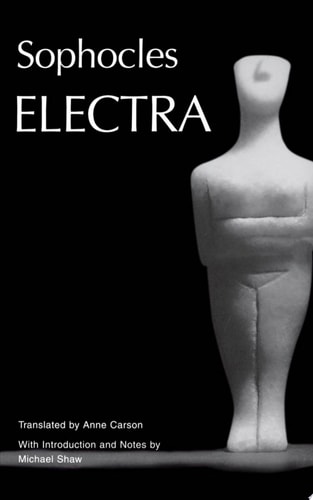
Electra
0
0
As an Amazon Associate and affiliate partner, Menrva Books earns from qualifying purchases. Learn more
Author Description
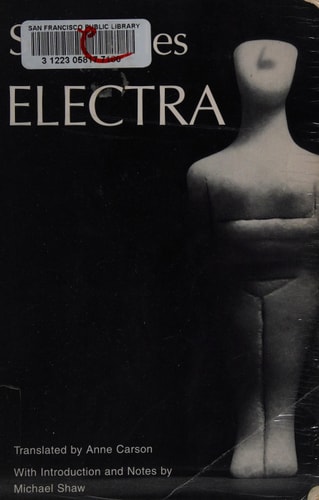
Based On The Conviction That Only Translators Who Write Poetry Themselves Can Properly Recreate The Celebrated And Timeless Tragedies Of Aeschylus, Sophocles, And Euripides, The Greek Tragedy In New Translations Series Offers New Translations That Go Beyond The Literal Meaning Of The Greek In Order To Evoke The Poetry Of The Originals. Under The General Editorship Of Peter Burian And Alan Shapiro, Each Volume Includes A Critical Introduction, Commentary On The Text, Full Stage Directions, And A Glossary Of The Mythical And Geographical References In The Play. Although It Has Been At Times Overshadowed By His More Famous Oedipus Tyrannus And Antigone, Sophocles' Electra Is Remarkable For Its Extreme Emotions And Taut Drama. Electra Recounts The Murders Of Clytemnestra And Aegisthus By Clytemnestra's Son Orestes, To Avenge Their Murder Of His Father Agamemnon, Commander Of The Greeks At Troy, Upon His Return Home. Sophocles' Version Is Presented From The Viewpoint Of Electra, Orestes' Sister, Who Laments Her Father, Bears Witness To Her Mother's Crime, And For Years Endures Her Mother's Scorn. Despite Her Overwhelming Passion For Just Revenge, Electra Admits That Her Own Actions Are Shameful. When Orestes Arrives At Last, Her Mood Shifts From Grief To Joy, As Orestes Carries Out The Bloody Vengeance. Sophocles Presents This Story As A Savage Though Necessary Act Of Vengeance, Vividly Depicting Electra's Grief, Anger, And Exultation. This Translation Equals The Original In Ferocity Of Expression, And Leaves Intact The Inarticulate Cries Of Suffering And Joy That Fill The Play.
Menrva's Summary
THE PULSE
The central conflict ignites when Electra, consumed by grief and resentment, awaits the return of her brother Orestes to execute vengeance against their mother for the murder of their father, Agamemnon. Electra occupies a state of perpetual mourning and social isolation within the palace, serving as the primary witness to the corruption of her household. Her objective is the restoration of justice through the death of Clytemnestra and Aegisthus, a goal that forces her to navigate the moral ambiguity of matricide. The narrative follows a linear progression toward a violent climax, utilizing the conventions of Greek tragedy to emphasize the psychological toll of prolonged suffering and the finality of retribution.
INSIDE THE PAGES
- Utilization of the traditional Greek chorus to provide moral commentary and atmospheric tension.
- Focus on the psychological interiority of the protagonist as she navigates her grief.
- Employment of dramatic irony regarding the return of Orestes.
- Exploration of the conflict between familial duty and moral conscience.
- Use of formal, poetic dialogue to heighten the emotional stakes of the confrontation.
- Incorporation of stage directions that emphasize the physical presence of the palace as a site of trauma.
- Examination of the cyclical nature of violence within the House of Atreus.
- Inclusion of a glossary to clarify the complex mythological and geographical references inherent in the text.
THE COLLECTIVE ECHO
Readers and critics frequently highlight the intensity of Electra's characterization, noting that her singular focus on vengeance distinguishes her from other figures in Sophoclean drama. Discussion often centers on the moral complexity of the play, as the audience is forced to weigh the necessity of justice against the horror of the required acts. Scholars often point to the play's taut pacing and the stark contrast between Electra's isolation and the eventual, swift execution of the plot. The work is widely regarded for its ability to convey raw, inarticulate suffering through structured, rhythmic language. Readers often find the play's examination of loyalty and betrayal to be as relevant today as it was in antiquity.
Page Count:
144
Publication Date:
2001-01-01
Publisher:
Oxford University Press
ISBN-10:
0199726477
ISBN-13:
9780199726479
Drama
Tragedy
Classical
Plays
Greek Mythology
Community Tags
Other Editions(17)
De Gruyter
2021
Default edition
Wyatt North
2021

Faber & Faber
2014

Faber & Faber
2014
Bloomsbury Academic
2012

Bloomsbury UK
2012

Digireads.com
2009
Hackett Publishing
2008

Kessinger Publishing, LLC
2004

Kessinger Publishing
2004

U P H
2001
Oxford University Press
2001
Oxford University Press
2001

Samuel French, Inc.
1997

Players Press
1995
Macmillan Pub Co
1950
Cambridge University Press
1920
Similar Books


Reader Comments
Share Your Thoughts
No comments yet. Be the first to share your thoughts!