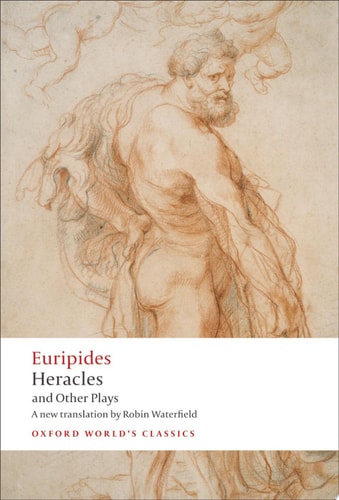
Heracles and Other Plays
0
0
As an Amazon Associate and affiliate partner, Menrva Books earns from qualifying purchases. Learn more
Author Description
Euripides wrote about timeless themes, of friendship and enmity, hope and despair, duty and betrayal. The first three plays in this volume are imbued with an atmosphere of violence, while the fourth, Cyclops, is our only surviving example of a genuine satyr play, with all the crude and slapstick humor that characterized the genre. Alcestis shows various reactions to death with pathos and grim humor while the blood-soaked Heracles portrays deep emotional pain and undeserved suffering. Children of Heracles deals with the effects of war on refugees and the consequences of sheltering them.About the Series: For over 100 years Oxford World's Classics has made available the broadest spectrum of literature from around the globe. Each affordable volume reflects Oxford's commitment to scholarship, providing the most accurate text plus a wealth of other valuable features, including expert introductions by leading authorities, voluminous notes to clarify the text, up-to-date bibliographies for further study, and much more.
Menrva's Summary
THE PULSE
The central conflict arises from the intersection of divine intervention and human suffering, forcing characters to confront the limits of their agency against the backdrop of fate. Euripides presents a series of narratives where protagonists grapple with extreme emotional and physical duress, ranging from the domestic tragedy of Alcestis to the chaotic, comedic elements of the satyr play Cyclops. These works utilize a formal structure of dialogue and choral odes to explore the moral complexities of duty, betrayal, and the consequences of war. The narrative framework relies on the conventions of ancient Greek theater, emphasizing the public nature of private agony and the inescapable influence of the gods.
INSIDE THE PAGES
- Utilization of the traditional Greek chorus to provide commentary and thematic context.
- Integration of satyr play elements, specifically in Cyclops, to provide tonal contrast.
- Exploration of the psychological impact of war on displaced populations.
- Examination of the tension between individual desire and societal or divine obligation.
- Use of pathos and grim humor to heighten the emotional stakes of the tragedy.
- Focus on the domestic and political ramifications of heroic actions.
- Stylistic reliance on rhetorical debate to articulate conflicting moral viewpoints.
- Incorporation of mythological figures to ground the narrative in cultural tradition.
THE COLLECTIVE ECHO
Readers and critics frequently highlight the stark contrast between the intense, blood-soaked tragedy of Heracles and the bawdy, slapstick nature of the satyr play included in this volume. Discussion often centers on Euripides' ability to humanize mythological figures by placing them in situations defined by despair and undeserved suffering. Scholars appreciate the balance of character development, noting that the playwright prioritizes internal emotional states over simple plot progression. The atmosphere is consistently described as heavy with the weight of fate, yet the inclusion of dark humor provides a necessary relief that keeps the narratives from becoming purely nihilistic. This collection is widely regarded as an effective entry point for those interested in the evolution of ancient Greek dramatic structure.
Page Count:
161
Publication Date:
2008-11-15
Publisher:
Oxford University Press
ISBN-10:
0199555095
ISBN-13:
9780199555093
Drama
English drama
Tragedy
Classical
Plays
Greek Mythology
Community Tags
Other Editions(3)

Similar Books