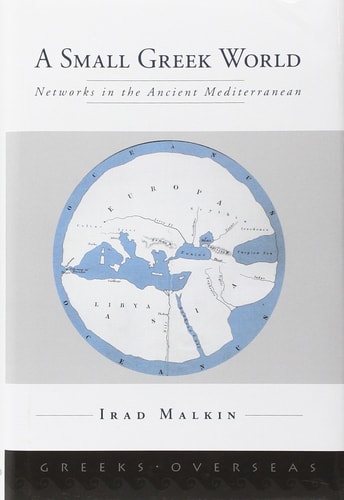
A Small Greek World: Networks in the Ancient Mediterranean
0
0
As an Amazon Associate and affiliate partner, Menrva Books earns from qualifying purchases. Learn more
Author Description
Greek civilization and identity crystallized not when Greeks were close together but when they came to be far apart. It emerged during the Archaic period when Greeks founded coastal city states and trading stations in ever-widening horizons from the Ukraine to Spain. No center directed their diffusion: mother cities were numerous and the new settlements ("colonies") would often engender more settlements. The "Greek center" was at sea; it was formed through back-ripple effects of cultural convergence, following the physical divergence of independent settlements. "The shores of Greece are like hems stitched onto the lands of Barbarian peoples" (Cicero). Overall, and regardless of distance, settlement practices became Greek in the making and Greek communities far more resembled each other than any of their particular neighbors like the Etruscans, Iberians, Scythians, or Libyans. The contrast between "center and periphery" hardly mattered (all was peri-, "around"), nor was a bi-polar contrast with Barbarians of much significance.Should we admire the Greeks for having created their civilization in spite of the enormous distances and discontinuous territories separating their independent communities? Or did the salient aspects of their civilization form and crystallize because of its architecture as a de-centralized network? This book claims that the answer lies in network attributes shaping a "Small Greek World," where separation is measured by degrees of contact rather than by physical dimensions.
Menrva's Summary
THE THESIS
Does the crystallization of Greek civilization stem from the physical challenges of distance, or is it a direct result of its architecture as a decentralized network? Irad Malkin, a scholar of ancient history, utilizes network theory to re-examine the expansion of Greek city-states during the Archaic period. By analyzing the patterns of settlement and cultural exchange across the Mediterranean, the author argues that the "Greek world" functioned as a system defined by degrees of contact rather than traditional geographic centers or peripheries.
THE SCOPE MAP
What You Will Find
- Analysis of Archaic period settlement patterns from the Ukraine to Spain
- Application of network theory to ancient Mediterranean colonization
- Examination of cultural convergence versus physical divergence in independent city-states
- Comparative study of Greek identity against neighboring cultures such as the Etruscans and Iberians
THE AUTHORITY PERSPECTIVE
Scholars and historians frequently cite this work as a significant contribution to the study of ancient Mediterranean connectivity. Readers often note the academic rigor of the text, which provides a sophisticated framework for understanding how decentralized societies maintain cultural cohesion over vast distances.
Page Count:
306
Publication Date:
2011-11-01
Publisher:
Oxford University Press
ISBN-10:
019973481X
ISBN-13:
9780199734818
History
Ancient History
Sociology
Archaeology
Greeks
Community Tags
Similar Books














