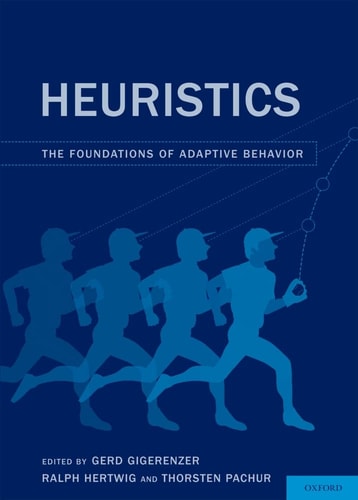
Heuristics: The Foundations of Adaptive Behavior
0
0
As an Amazon Associate and affiliate partner, Menrva Books earns from qualifying purchases. Learn more
Author Description
How do people make decisions when time is limited, information unreliable, and the future uncertain? Based on the work of Nobel laureate Herbert Simon and with the help of colleagues around the world, the Adaptive Behavior and Cognition (ABC) Group at the Max Planck Institute for Human Development in Berlin has developed a research program on simple heuristics, also known as fast and frugal heuristics. In the social sciences, heuristics have been believed to be generally inferior to complex methods for inference, or even irrational. Although this may be true in "small worlds" where everything is known for certain, this text argues that in the actual world in which we live, full of uncertainties and surprises, heuristics are indispensable and often more accurate than complex methods. Contrary to a deeply entrenched belief, complex problems do not necessitate complex computations. Less can be more. Simple heuristics exploit the information structure of the environment, and thus embody ecological rather than logical rationality. Simon (1999) applauded this new program as a "revolution in cognitive science, striking a great blow for sanity in the approach to human rationality."By providing a fresh look at how the mind works as well as the nature of rationality, the simple heuristics program has stimulated a large body of research, led to fascinating applications in diverse fields from law to medicine to business to sports, and instigated controversial debates in psychology, philosophy, and economics. In a single volume, the present reader compiles key articles that have been published in journals across many disciplines. These articles present theory, real-world applications, and a sample of the large number of existing experimental studies that provide evidence for people's adaptive use of heuristics.
Menrva's Summary
THE THESIS
This volume investigates the core question of how human beings effectively navigate decision-making under conditions of uncertainty, time constraints, and limited information. The authors, representing the Adaptive Behavior and Cognition (ABC) Group at the Max Planck Institute for Human Development, challenge the traditional academic view that complex problems require complex computational models. By building upon the work of Herbert Simon, they argue that simple, fast, and frugal heuristics often outperform sophisticated algorithms by exploiting the structure of the environment, a concept they define as ecological rationality.
THE SCOPE MAP
What You Will Find
- Theoretical foundations of fast and frugal heuristics in cognitive science.
- Empirical evidence demonstrating the accuracy of simple decision rules in uncertain environments.
- Cross-disciplinary applications including law, medicine, business, and sports.
- A compilation of key research articles and experimental studies from the ABC Group's program.
THE AUTHORITY PERSPECTIVE
Experts recognize this volume as a foundational text for understanding the shift toward ecological rationality in cognitive psychology. Readers frequently note the academic density of the prose, which serves as a comprehensive reference for researchers and students interested in the mechanics of human judgment.
Page Count:
872
Publication Date:
2011-04-15
Publisher:
Oxford University Press
ISBN-10:
0199744289
ISBN-13:
9780199744282
Psychology
Philosophy
Decision Making
Community Tags
Similar Books